Teaching Note Reading to Beginner Piano Students: The Landmark Method (Free Printable)
Free 5-page landmark note-reading package for beginner piano students. Learn why the landmark and interval method builds stronger sight-reading than mnemonics alone.
TEACHING TIPSMUSIC THEORY
Kristin Serrick
9/20/20253 min read
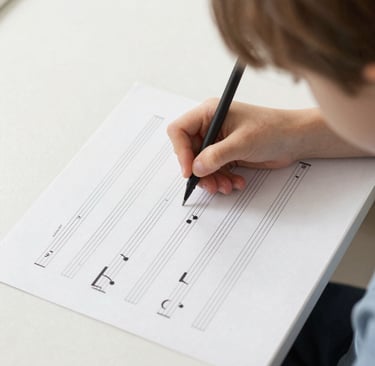
Hi Students and Fellow Teachers!
If you teach beginner piano students, you've almost certainly wrestled with the note-reading question: what's the best way to get students reading the staff confidently and independently?
Today I'm sharing a free 5-page note-reading package built around the landmark method — one of my favourite approaches for beginner music students. But first, let me explain why I teach it this way, because I think the reasoning matters.
Mnemonics: Helpful, But With a Catch
Most of us learned our note-reading mnemonics and still remember them decades later. Every Good Boy Deserves Fudge. FACE. Good Boys Deserve Fudge Always. All Cows Eat Grass. They're catchy, they're easy to introduce, and there's a reason teachers have used them forever.
But here's the problem I've noticed over years of teaching: students who rely too heavily on mnemonics often become dependent on them. Their sight-reading slows down because they're mentally reciting a phrase rather than recognizing a note. And perhaps more importantly, they miss the relationships between notes — the patterns, the intervals, the visual logic of the staff.
Why I Prefer the Landmark and Interval Method
I'm a big believer in intervallic and pattern-based reading. Here's the thinking behind it.
In one of my ESL training sessions, I learned that students can hold approximately seven individual items in short-term memory at once. For note-reading, that means every note a student has to decode individually is using up one of those slots. The goal should be to reduce the number of "items" the brain is processing — and patterns do exactly that.
Take the triad. A student who recognizes the visual shape of a triad in any inversion is processing one pattern, not three separate notes. One item in working memory instead of three. That's a meaningful difference, especially for younger learners.
The landmark method works the same way. Rather than decoding every note from scratch, students anchor their reading to a small set of known reference points and navigate from there.
The Landmarks
Middle C is the natural starting point — it sits right in the middle of the grand staff, making it an ideal anchor for both hands.
Most beginner method books introduce Middle C early, often with one or both thumbs placed on it. From there, students can find their next landmarks immediately: if they place their fifth fingers on both hands, they land two lines up in the Treble clef and two lines down in the Bass clef. That's three landmarks established in a single hand position.
From there, I find it helpful to introduce Treble D and Bass B together, and Treble E and Bass A together. These pairs are close enough visually that students sometimes confuse them — working on them side by side helps avoid that mix-up before it becomes a habit. I've included a dedicated page in this package for students to practice writing these notes with intention. While they write their Treble E's, have them say it out loud: "bottom line, bottom line, E lives on the bottom line." For Bass A: "top line, top line, A pokes through the top line." That combination of writing and speaking is one of the most effective ways to move information from short-term into long-term memory.
What's in the Free Download
This free 5-page package includes:
An introduction to the landmark notes on the grand staff
Middle C, Treble G, and Bass F landmark practice
Treble D / Bass B practice pages
Treble E / Bass A practice pages
Writing and recognition exercises throughout
It's designed to complement any beginner method book and works well as a theory supplement or take-home practice sheet.
Download It Free
The landmark note-reading package is available as a free download in the PPT store. Sign up with your email and download all five pages instantly.
However you teach note reading in your studio, I hope this gives your students a strong and confident foundation. The goal is always the same — joy in the journey and real musical independence.
Happy teaching, Ms. Kristin
© 2026 The Paperless Piano Teacher. All Rights Reserved.
The Paperless Piano Teacher
The ultimate one-stop shop for music lesson planning. Helping teachers inspire the next generation of musicians.