
This Arabesque is often the piece that first makes a student feel fast and capable. It is an étude that feels like a character piece: beneath the flashy sixteenth-note runs is a compact formal design and focused technical goal. That is why it fits naturally into the RCM étude category. Its simple goal: play lightly and evenly. Seeing the structure helps students learn it in manageable pieces instead of one intimidating rush, so here is the whole thing mapped out, then the tips I use to keep it clean.
- Composer
- Burgmüller
- Set
- Op. 100, No. 2
- Key
- A minor
- Form
- Rounded Binary
- Metre
- 2/4
- Level
- RCM Level 3
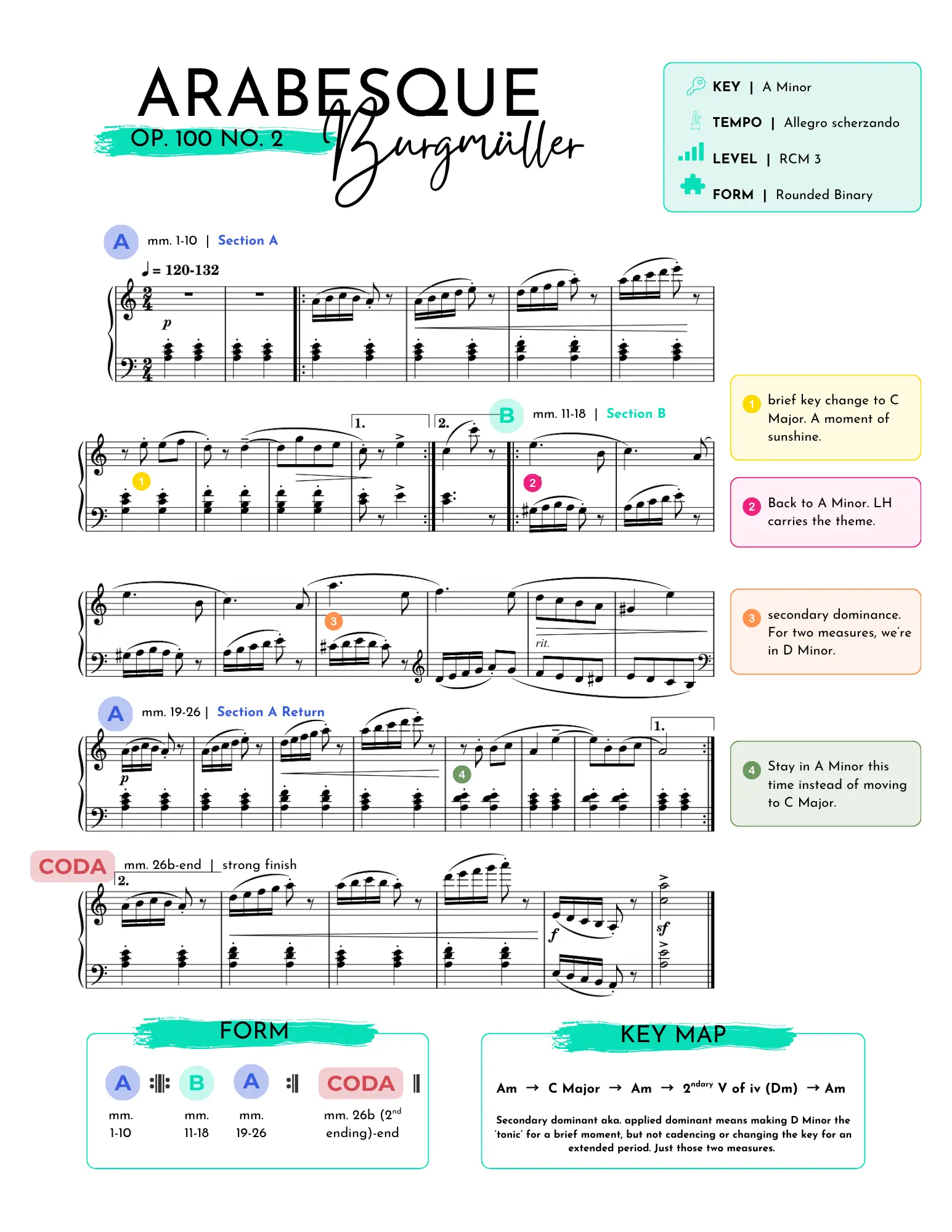
The big picture: rounded binary form
Arabesque is a rounded binary: two repeated halves, even though your ear hears three ideas. The first half states the opening (A) and ends away from home, in the relative major. The second half brings a contrasting idea (B) and then rounds the piece off by bringing the opening back—so the return of A lives inside that second half, paired with B, rather than standing alone as a third section. The repeat signs around each half are what make it binary; the returning opening is what makes it "rounded." It is one of Burgmüller's 25 Progressive Pieces, Op. 100—written to teach—so the design is deliberately clear. For a student that means three short ideas to learn (opening, contrast, return) organised into two chunks to practise and memorise.
Section by section
- A — the opening (A minor). Quick, light sixteenth-note figures in the right hand over crisp, staccato left-hand chords. The decorative running line evokes the curving, ornamental quality associated with an arabesque. It ends with a brief tonicization of its relative major: C major.
- B — the middle. The music re-establishes A minor, while the running motion shifts to the left hand. It is the contrast that gives the piece shape. The middle section briefly tonicizes D minor, the subdominant key. Its applied dominant introduces C♯, temporarily making D minor sound like a local tonic.
- A — return, then a short close. The opening comes back, and a brief coda drives to a firm ending in A minor.
The whole piece exists to train light, even sixteenth notes. If a student can play those cleanly and quietly, they have "got" the piece. Everything else will flow. Aim your practice there rather than at the notes that already feel comfortable.
A few teaching tips
- Light, not loud. The sixteenths should be even and quiet, played from the fingers. Stay close to the keys and support with a steady flexible hand and wrist. Practising them piano first stops the tension and banging that come from trying to play them fast and forte.
- Crisp left-hand staccato. The chords want a light wrist bounce, not a heavy drop. Keep them short and soft so they punctuate rather than cover the melody.
- Practise in rhythms and articulations. For the runs, practising in dotted and reverse-dotted rhythms evens out the fingers and exposes which notes are lagging.
- Shape the contrast. Spend time with your left hand in Section B and don't rush the transition in measure 17-18. Work through the fingering with intention.
- Tempo is a destination, not a start. Secure it slowly and evenly first; the "fast and capable" feeling arrives on its own once the evenness is there.
Arabesque Analysis (Printable)
A print-ready copy of the colour-coded form map to keep in the studio or hand to a student.
More analysis & theory
Explore more piece analyses and teaching ideas, or build the underlying skills with music theory worksheets for form, harmony, and analysis.