
"Bach" is rarely just one person. Ask a student to place the composer in history and you often get a tangle: which Bach wrote this, and was that the son or the father? The family produced musicians for generations, and a simple family tree turns that confusion into something a student can take in at a glance.
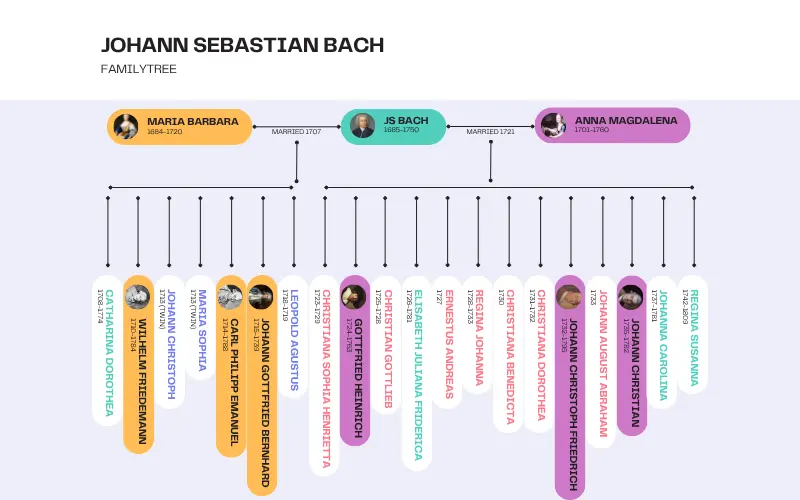
Bach Family Tree
A colour-coded tree of J.S. Bach's family with dates, plus a blank version for students to fill in.
Why a family tree helps
Music history asks students to place people and works in time, and names alone make that hard—especially with a family that reused first names across generations. A tree replaces a list of facts with a picture of relationships: who came first, who was whose child, and which of them went on to compose. Once a student can see the shape of the family, the individual names have somewhere to live.
It also quietly builds era awareness. J.S. Bach anchors the end of the Baroque, while several of his sons wrote in the emerging Classical style. Seeing that on one page plants the idea that eras overlap through real people, not tidy date lines.
What is in the printable
The download is a colour-coded family tree of Johann Sebastian Bach's household—both wives and all twenty children, with names and birth and death dates—with his most famous composer descendants, such as Carl Philipp Emanuel and Wilhelm Friedemann, highlighted so they stand out from the wider family. It also includes a blank tree for students to complete themselves.
Reading a finished chart is useful, but filling one in is where it sticks. Building the tree themselves turns a reference sheet into an activity.
How I use it in lessons
- As an anchor before the details. When we first meet Bach, I put the tree in front of the student so they have a frame to hang everything else on, rather than meeting the family piecemeal across weeks.
- To settle the "which Bach?" question. The moment a student confuses J.S. Bach with one of his sons, the chart answers it instantly and visually—far better than me simply restating it.
- As a fill-in activity. I hand over the blank version and we build it together, or I send it home. Placing each name themselves is what moves the family from a blur to something they know.
- As a bridge into the eras. Pointing to the generation that shifted toward the Classical style makes an abstract transition concrete, and sets up later work comparing the periods.
Putting it to work
Print the finished tree as a reference to keep in a student's binder, and use the blank version as the activity. It pairs naturally with the rest of the music history resources—composer references, era comparison charts, and required-listening study tools—so a lesson on Bach can move outward from the family into the wider Baroque.
More music history support
Explore the full set of music history resources for composer charts, era comparisons, glossary tools, and required-listening study sheets built for lessons and exam prep.