
Chopin's Nocturne in E-flat Major, Op. 9 No. 2 is instantly recognizable, yet it asks for far more than a beautiful melody and plenty of pedal. The left hand must provide a calm harmonic foundation, the right hand must sing and decorate without losing the phrase, and the rubato must feel free without allowing the music to lose its direction. The form helps: once students recognize the melody's returns, they can hear each ornament as part of a developing story rather than as a new collection of notes.
- Composer
- Frédéric Chopin
- Work
- Op. 9 No. 2
- Key
- E♭ major
- Design
- Ornamented returns + coda
- Metre
- 12/8
- RCM
- Level 9
A young Chopin and an established genre
Op. 9 contains three nocturnes written early in Chopin's career and issued in first editions in 1832–33. The set was dedicated to Madame Camille Pleyel, a prominent pianist. Chopin did not invent the piano nocturne—John Field's lyrical pieces helped establish the genre—but he made it central to Romantic piano music, expanding its harmony, ornamentation and expressive range.
The E-flat-major Nocturne is only 34 measures long. Its first French edition appeared in 1833, and surviving first editions and pupils' copies preserve revisions and variants associated with Chopin. That is a useful reminder that ornamentation in this music is not decorative frosting: reshaping the melody was part of Chopin's musical language.
Nocturne means “night piece”. It's a short piece inspired by the atmosphere of night. In Chopin’s hands, the genre often features a singing melody over a flowing accompaniment. Chopin did not provide a specific story or program for Op. 9 No. 2, so get creative with your own inspiration.
The big picture: a melody transformed
This Nocturne is sometimes labelled rounded binary or a rondo-like design. Neither label tells the whole teaching story. What students hear most clearly is a recurring opening melody alternating with contrasting phrases (which is probably most closely associated with rondo form) followed by a coda. Each return is more decorated or intensified than the last.
A practical map is A–A′–B–A″–B′–A‴–Coda. The letters show recognition and contrast; the prime marks show that Chopin never simply copies and pastes the melody.
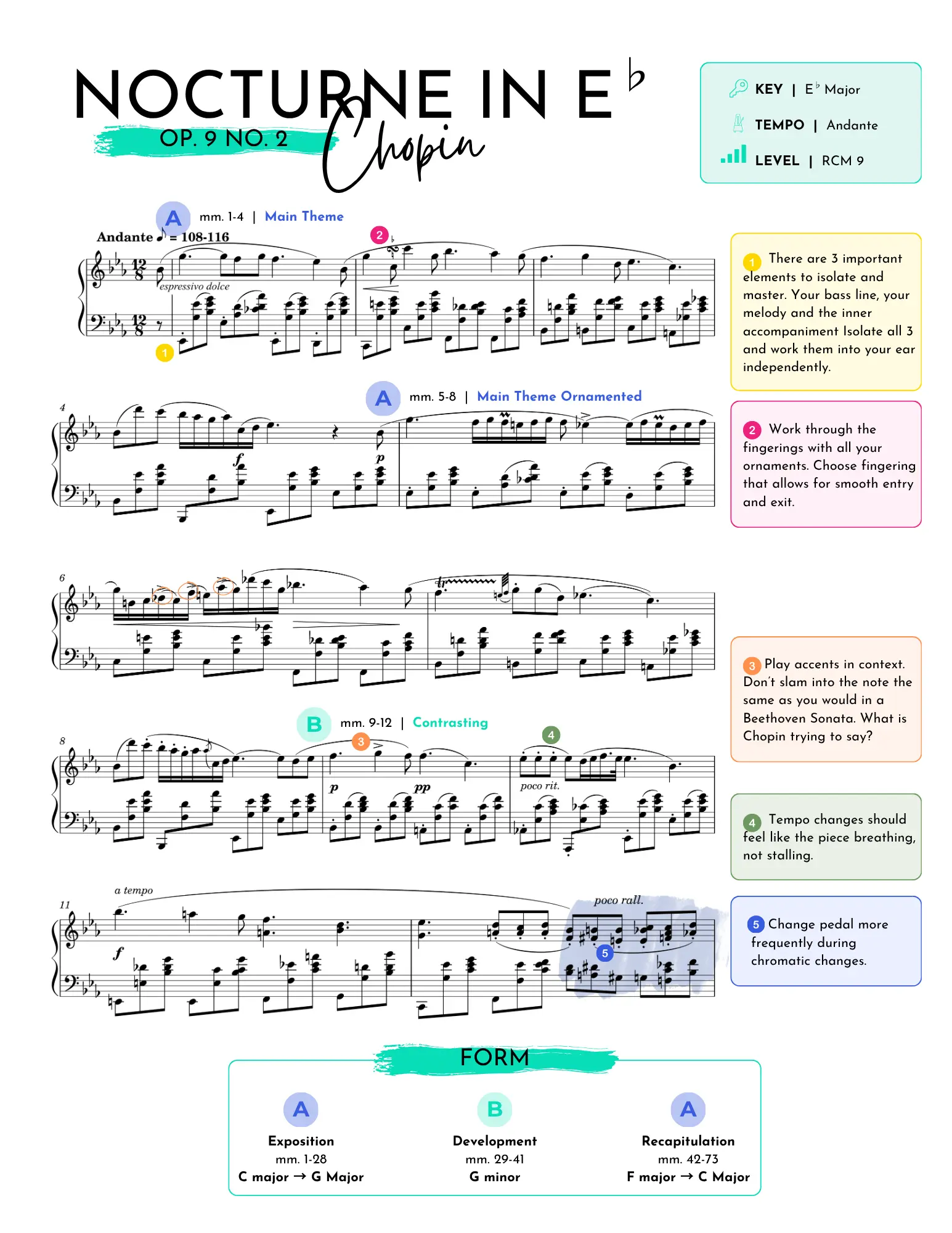
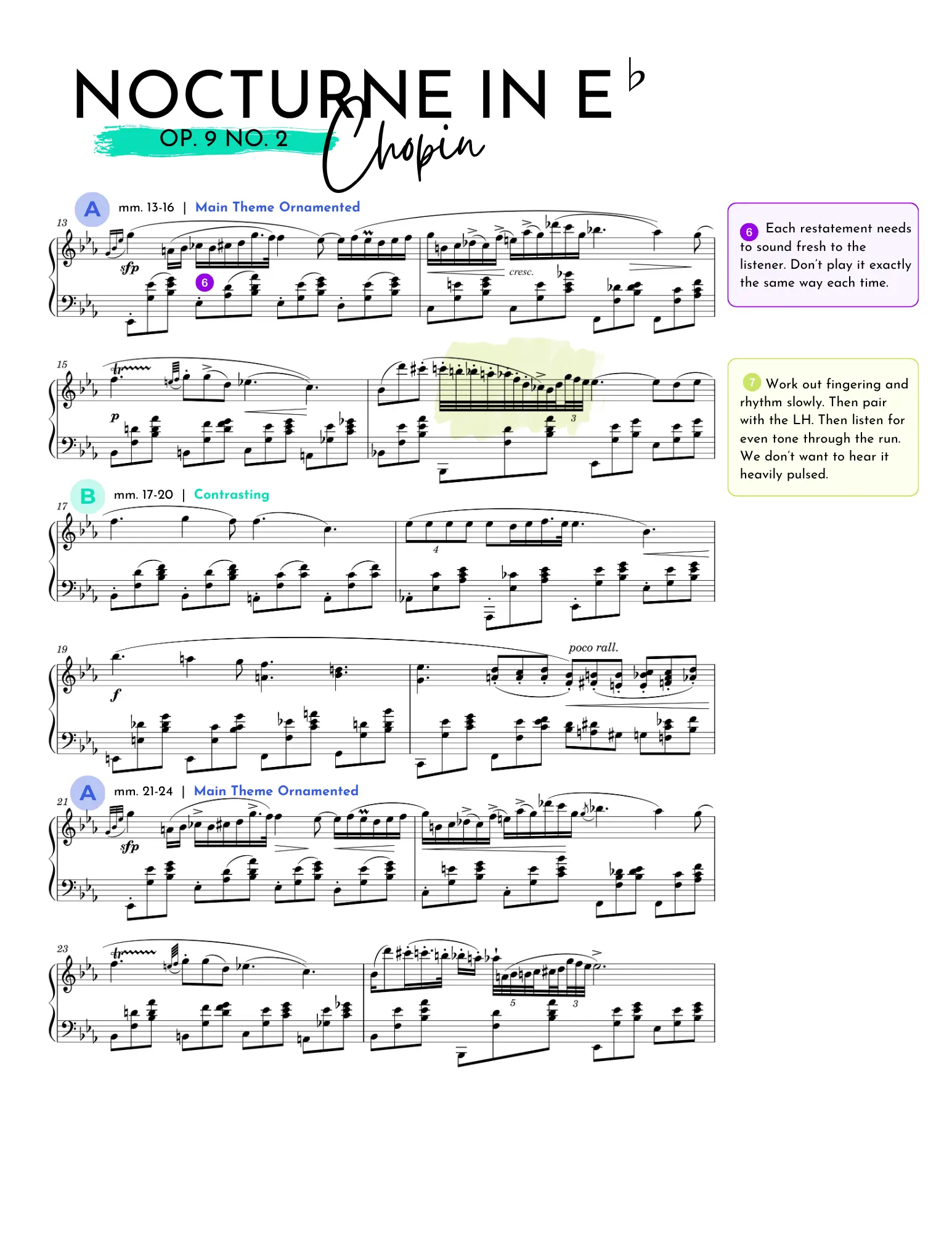
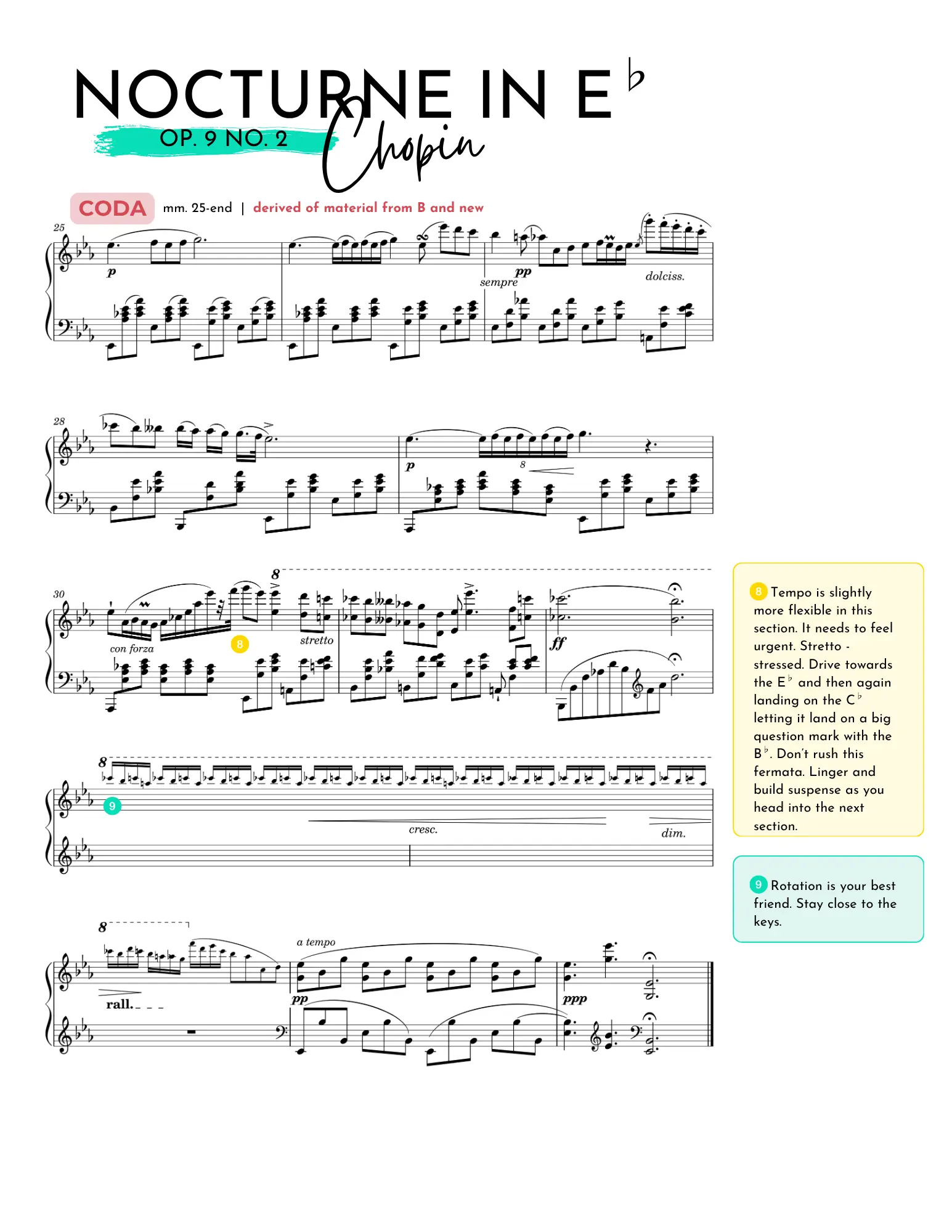
Section by section
- A — the opening melody. The right hand enters after an upbeat and unfolds in four-bar phrases over widely spaced broken chords. E-flat major feels secure, but expressive appoggiaturas and chromatic notes give the line its longing.
- A′ — the first varied return. The melody is recognizable, with added decoration. Students should hear the same destination underneath the extra notes.
- B — contrast and harmonic movement. The melody reaches farther and the harmony becomes less settled. Sequential motion and stronger dissonances create a question before the opening idea returns.
- A″ — a more ornamented return. Chopin elaborates the line without changing its basic phrase purpose. The skeleton melody must remain audible.
- B′ and A‴ — growing intensity. Familiar material returns with wider gestures, denser ornamentation and a stronger approach to the climax.
- Coda. The final embellishment becomes especially free, including the famous senza tempo gesture. Trills and a descending close release the accumulated tension into E-flat major.
Harmony underneath the beautiful surface
The left hand is more than accompaniment: it tells us where each phrase is going. Its bass notes and changing chord colours create tension while the melody lingers above. Students do not need a Roman numeral under every beat, but they should recognize the tonic E-flat, dominant B-flat, important predominant harmonies, chromatic intensifications and the cadences that close or reopen the conversation.
Block each left-hand measure into a chord and play the bass line alone. Then identify the harmonic arrival at the end of each four-bar phrase. This turns a page of repeated broken chords into a map and makes both pedalling and memorization safer.
Make the melody sing
- Practise the skeleton melody. Remove the ornaments and play only the principal melodic notes. Shape that line before restoring the decoration.
- Use supported finger contact. A singing tone comes from a controlled key descent and connected arm support, not from squeezing or pressing after the key is down.
- Balance melody notes within ornaments. Decide which notes carry the line and which lead toward them. Not every note in a turn or run deserves equal weight.
- Listen to the end of long notes. The phrase continues while a melody note is held and the harmony moves underneath it.
The left hand: steady, flexible and quiet
Practise the bass alone in groups of four large beats per measure, not twelve separate eighth notes. Land on the bass with a comfortable arm movement, then travel lightly through the upper chord notes. The leaps should feel planned and circular rather than like repeated sideways jumps.
Block the harmony first, then practise bass-to-chord placement silently. When the pattern returns, keep the bass clear but the inner notes transparent. The left hand must remain dependable enough to support rubato without sounding mechanical.
Rubato without losing the phrase
Rubato means flexible time, not random slowing. First play with a stable pulse and hear the four large beats in 12/8. Then allow the melody to lean, wait or move ahead around expressive notes while the left hand retains an underlying sense of continuity.
I ask students to identify where they are borrowing time and where the phrase gently gives it back. If every ornament causes a pause, the music becomes episodic. Save the greatest freedom for places where Chopin specifically expands the gesture, especially the coda's senza tempo. Singing is an incredibly useful skill when it comes to phrasing and rubato. Chopin was, afterall, the 'poet of the piano' and the singing quality to his pieces are characteristic.
Pedalling through changing harmony
- Learn the legato and balance without pedal first.
- Change pedal with the harmony, usually after the new bass sounds.
- Use shallower pedal where chromatic inner voices would blur.
- Clear before important rests, cadences and changes of colour.
- Adjust to the instrument and room; one fixed pedal plan will not suit every piano.
The goal is resonance with readable harmony. Record from several feet away: if the bass changes disappear into a wash, the pedal needs more frequent or shallower clearing.
A practical lesson plan
- Colour the A returns, B phrases and coda.
- Play and sing the unornamented melody.
- Block the left-hand harmonies and mark phrase-ending cadences.
- Combine the skeleton melody with the left hand before restoring ornaments.
- Add pedal one harmonic change at a time.
- Choose one expressive destination for each four-bar phrase.
- Record the first and final return; make sure the emotional journey is audible.
Chopin Nocturne Analysis (Printable)
A print-ready colour-coded form and phrase map for the studio or a student's score study.
Sources and further reading
More Chopin analysis
Explore the harmony and long-line teaching in Chopin's Prelude in E Minor, Op. 28 No. 4, or browse all piano analyses.