
If you want to teach a student what sonata form actually is, this is the piece. Clementi was one of Europe's greatest piano teachers, and these sonatinas became some of the most influential teaching pieces ever written. The first movement of No. 1 lays out sonata form so cleanly that a student can see every part. Learn the piece and you learn the form—so here is the first movement mapped, with the two themes and three big sections marked, then the tips I use.
- Composer
- Clementi
- Work
- Op. 36, No. 1 (mvt 1)
- Key
- C major
- Form
- Sonata form
- Tempo
- Allegro
- Level
- RCM Level 3
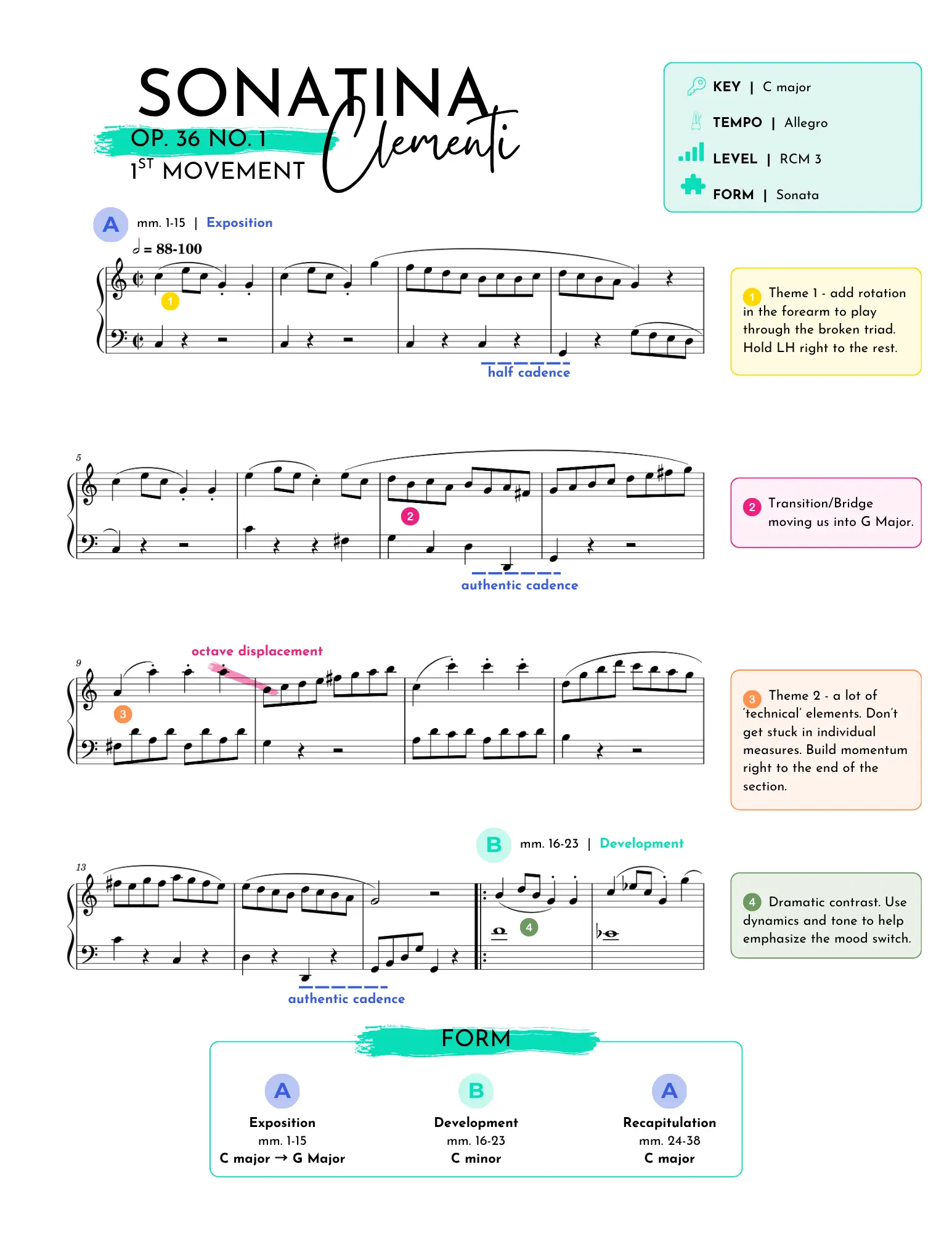
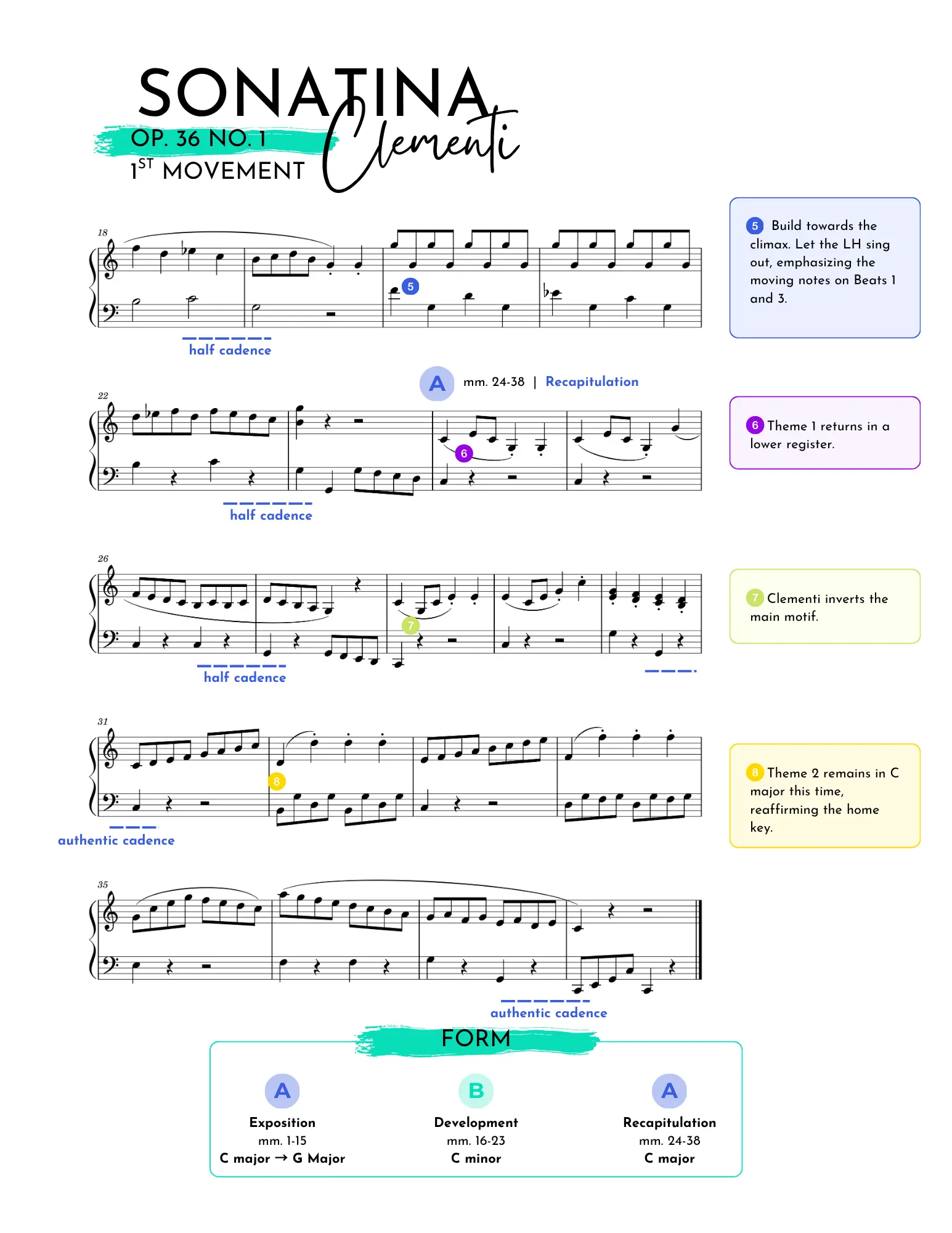
The big picture: sonata form
Sonata form has three big sections—exposition, development, and recapitulation—and two main themes that travel through different keys. The whole "story" is about leaving the home key and coming back to it. This movement tells that story in miniature, which is why it maps so beautifully onto a colour-coded chart.
Section by section
- Exposition — Theme 1 (C major). A bold, confident opening in the home key, with a broken-chord left hand driving it forward.
- Exposition — Theme 2 (G major). After a short bridge (transition), a lighter, more scalar second theme arrives in the dominant, G major. Two contrasting characters, two different keys; that is the heart of the exposition.
- Development. A short middle section takes fragments of the themes through other keys and a touch of minor colour, building tension before steering back home. The development's job is to create instability and/or contrast. One of the easiest ways to do that is to avoid establishing a key or tonic, or moving to a different key altogether. Here we move through C minor which has a very different mood or colour from the rest of the piece.
- Recapitulation. Theme 1 returns in C major and, crucially, so does Theme 2, now also in C major rather than G. Everything resolves into the home key.
In the exposition, Theme 2 is in G major; in the recapitulation, it returns in C major. That single change—the second theme resolving into the tonic—is the whole point of sonata form. Show a student those two spots side by side and the form suddenly makes sense.
A few teaching tips
- Teach the form with the colours first. Before drilling notes, walk through the sonata-form map together so the student knows they are learning four ideas (two themes, twice) rather than pages of new material.
- Light, even broken-chord bass. The left-hand accompaniment (Alberti bass) should stay quiet and even so the melody sings. Practise it alone until it is effortless.
- Clean scale fingering. The second theme and transitions lean on scale patterns—settle the fingering early so speed does not expose it later.
- Give the two themes two personalities. Theme 1 bold and rhythmic, Theme 2 lighter and singing. Deciding their characters makes the piece musical, not mechanical.
- Use the recap as a memory tool. Because the recapitulation repeats the exposition's material in the home key, a student who understands that only has to learn the differences—far less to memorise.
- Mark the phrases. Clementi sticks to a consistent 4 measure phrase structure. Marking these can help students visualize the line. Otherwise, they can play to the measure instead of the longer phrase.
- Cut Time. How does the piece feel in common time vs. cut time? What does cut time offer and why is that important? By moving towards beat 1 instead of 1 and 3, we create a sense of forward motion.
- Technique Given Purpose This kind of piece gives technique practice the 'why'. Dive in and see where scales, chords and cadences occur.
Muzio Clementi is sometimes called the "Father of the Pianoforte." While Mozart and Beethoven became more famous as composers, Clementi helped shape modern piano technique through his teaching, his music, and even the pianos he built and sold.
Clementi Sonatina Analysis (Printable)
A print-ready copy of the colour-coded sonata-form map to keep in the studio or hand to a student.
More analysis & theory
Explore more piece analyses and teaching ideas, or build the underlying skills with music theory worksheets for form, harmony, and analysis.