Note reading gets rushed. It is tempting to jump a beginner straight to naming notes on flashcards, but a student who has never really looked at how a note is built, or connected the symbol to a key, is memorising on sand. These three worksheets slow that first stage down just enough: see the note, form the note, then place it on the keyboard.
See it: music note tracing
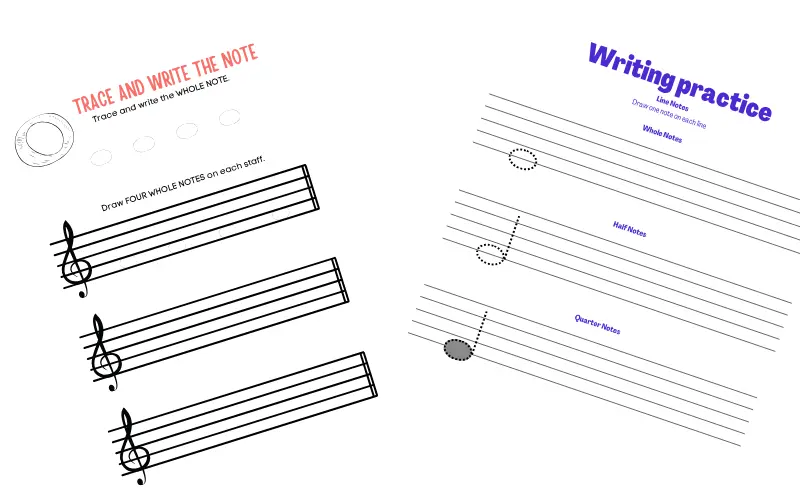
Before a student names or plays a note, tracing lets them look closely at how it is actually built—the notehead, the stem, the flag—on a full-size staff. It sounds almost too simple, but forming the shape by hand slows a beginner down enough to notice where a note sits and what it is made of, which pays off the moment they start reading for real.
Music Note Tracing
Trace noteheads, stems and flags on a full-size staff before naming or playing them.
Form it: music note writing
Once a student can see a note clearly, writing is the next step. This worksheet gives guided practice placing notes on lines and in spaces, one at a time, until the line-versus-space distinction stops being a guess. Writing a note is a more demanding skill than reading one, and students who can write notes confidently tend to read them confidently too.
Music Note Writing
Guided practice writing notes on lines and in spaces, one at a time, until it is no longer a guess.
Place it: piano note matching
The final gap for a beginner is the one between the page and the keyboard. This worksheet has students match written notes to their keys, so a note on the staff and a key under the finger become the same thing. Closing that gap early is what stops the common problem of a student who can name a note on paper but freezes when asked to find it on the piano.
Piano Note Matching
Match written notes to keys on the keyboard, closing the gap between page and hand.
That sequence is the whole idea. Each worksheet builds the physical and visual familiarity that fast note-naming later depends on—so when you do move to speed, it holds.
How this fits early lessons
I do not spend a whole lesson on these—a few minutes each, spread across the first weeks, alongside playing. Tracing and writing make good short in-lesson activities or gentle homework; note matching comes out once a student knows a handful of notes and needs to connect them to the keys. Together they lay the groundwork, and from there a student is ready for landmark-note reading and steps-and-skips work in the wider music theory worksheets.
Keep building readers
Explore the full set of music theory worksheets for note reading, rhythm, intervals, and harmony—each aimed at turning what students see into confident playing.