
Almost every student wants to play Für Elise, but familiarity can hide how much is happening inside it. The piece begins as though Beethoven is quietly trying out a thought: delicate, hesitant, and conversational. From there, it grows warmer, retreats, erupts, and finally returns to that opening question. Its rondo form gives students a clear map, but the real teaching gold is in the story the returning theme allows us to tell.
- Composer
- Beethoven
- Key
- A minor
- Form
- Rondo
- Metre
- 3/8
- Tempo
- Poco moto
- Level
- RCM Level 7
Before the analysis: who was “Elise”?
Surprisingly, no one knows for certain. Beethoven wrote the piece in 1810 but did not publish it. The version we know appeared in 1867, forty years after his death, when the scholar Ludwig Nohl published a copy he said he had made from Beethoven's autograph manuscript. That autograph has since disappeared, so we cannot check either the music or the dedication against the original.
Nohl read the title as Für Elise, yet no “Elise” has been identified beyond doubt. Therese Malfatti is closely connected with the story: Beethoven knew her in 1810, had romantic hopes involving her, and the lost manuscript came through her circle. This led to the suggestion that Nohl may have misread Für Therese. Elisabeth Röckel and Elise Barensfeld have also been proposed. Each theory has its supporters and its problems, so the honest answer remains wonderfully open: we do not know who Elise was.
That uncertainty is more interesting than the cute legend that Beethoven composed the piece to woo a struggling piano student who later rejected him. There is no reliable evidence for that full story. But, I still love using a version of it in lessons as an imaginative prompt. “Imagine you are trying to tell someone something important, but you are not sure how they will respond” gives a student something to play to without pretending we know exactly what Beethoven felt. I'll have my students move through each section and imagine Beethoven's progression through is courtship. It may not be historically acurate, but it's fun and helps them connect to the piece.
The word bagatelle means a trifle or little thing. It describes the scale of the piece, not its difficulty or expressive value. I like to think of Beethoven's bagatelles as compact character pieces: a musical thought or emotional scene captured without the proportions of a sonata. That helps students play Für Elise intimately rather than trying to turn every phrase into a concerto.
The big picture: a little rondo
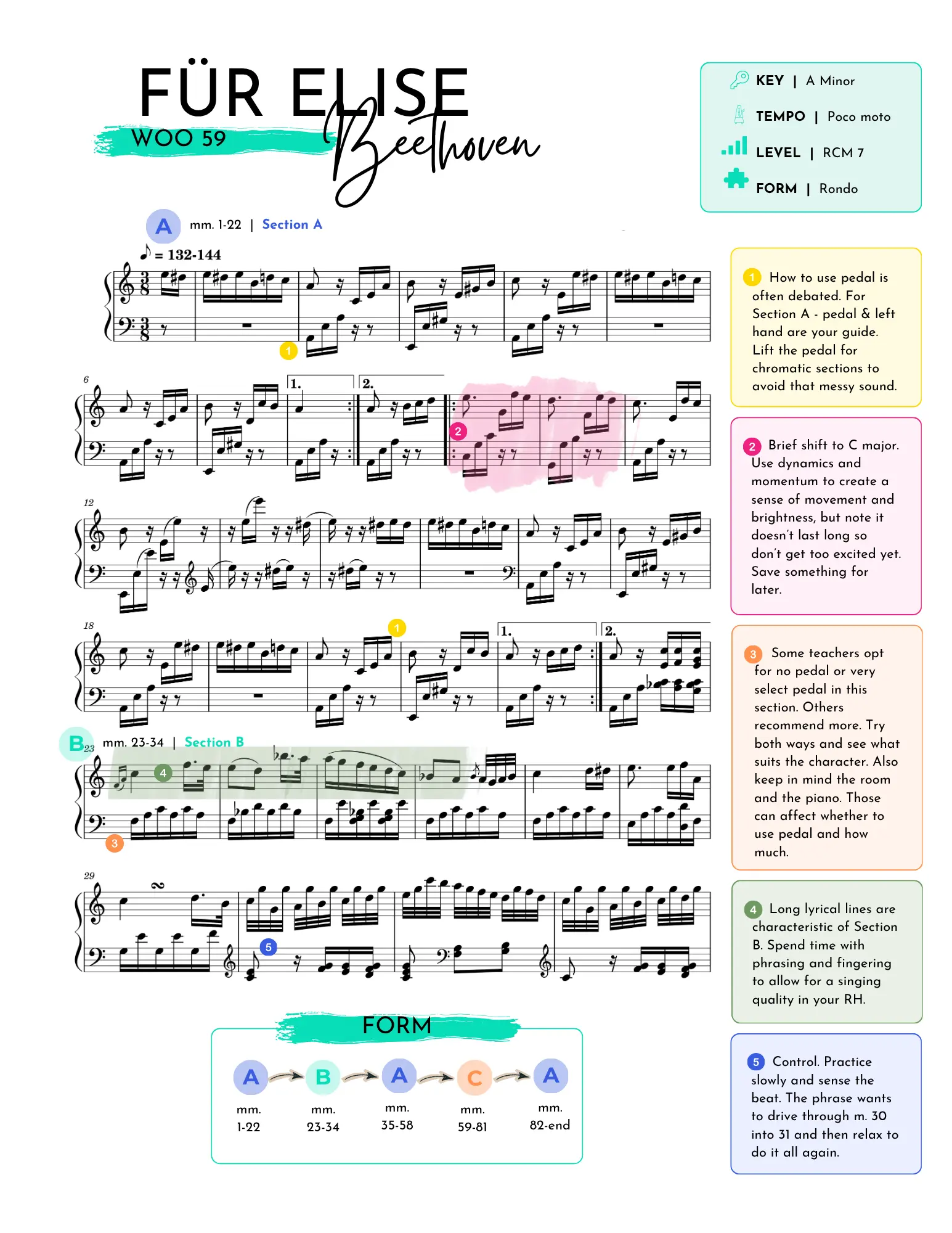
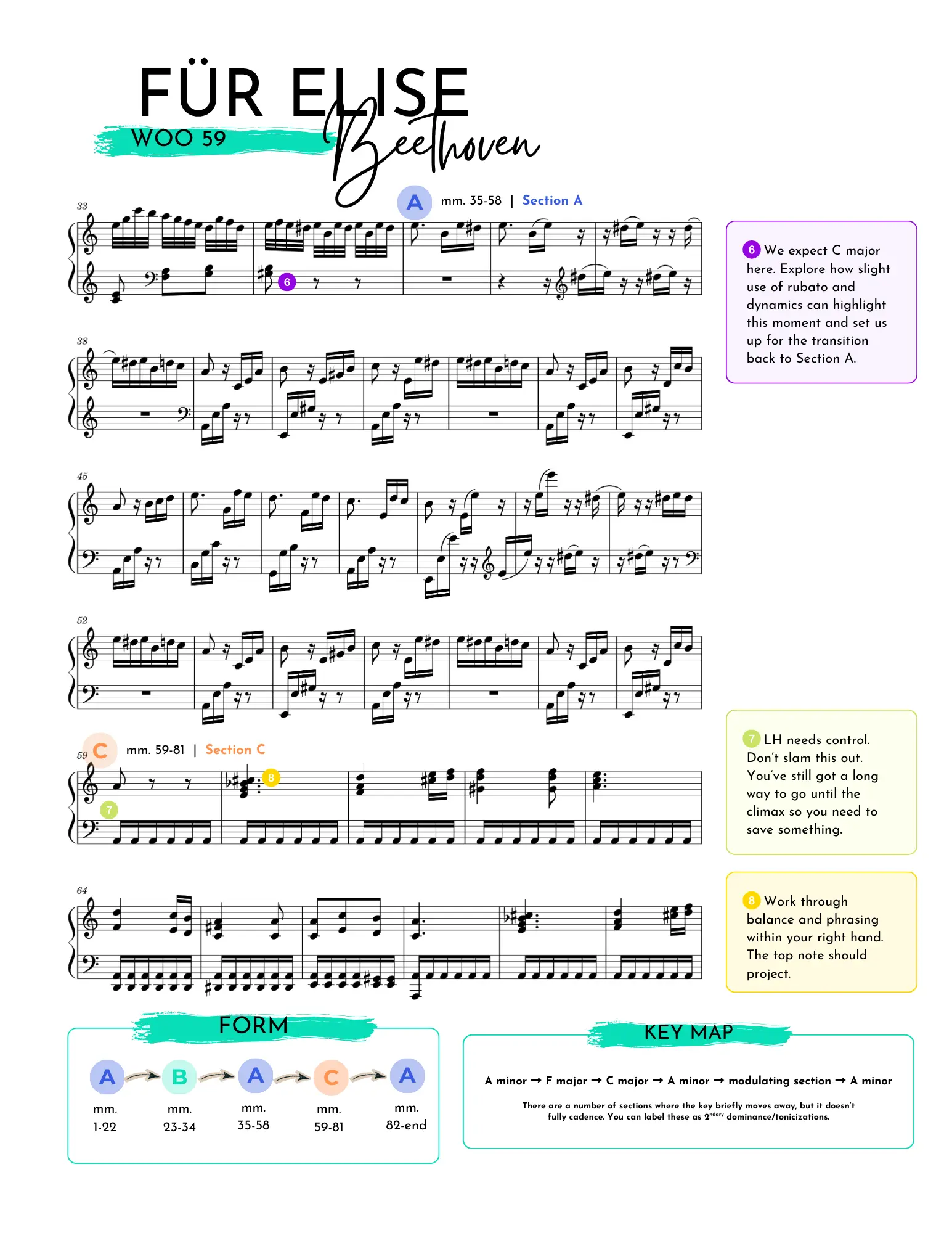
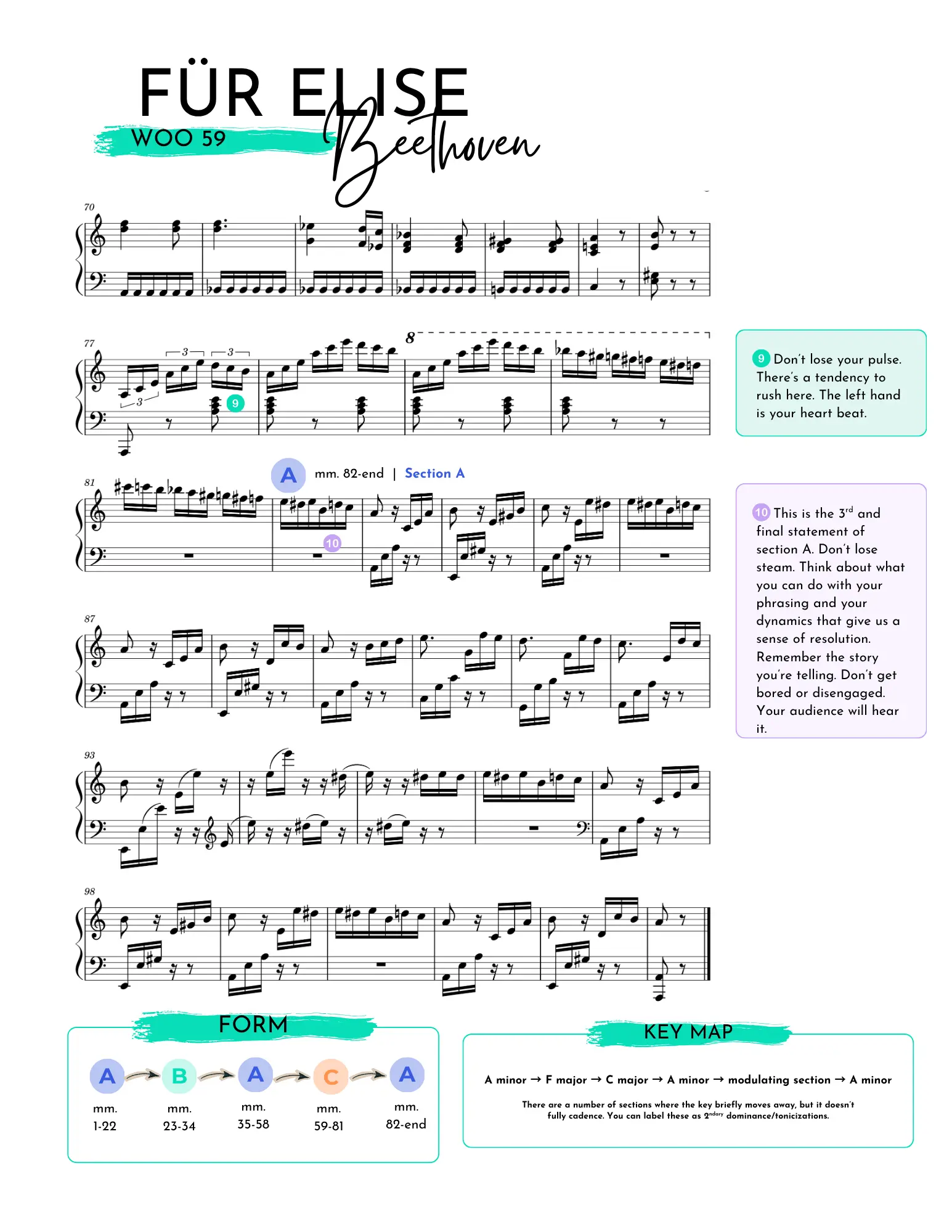
Für Elise is built as a rondo: one main theme keeps returning, with contrasting music between its appearances. Label the familiar refrain A and the two episodes B and C, and the whole piece becomes A–B–A–C–A. A student now has three kinds of material to learn instead of one long stream of notes—and, more importantly, can hear how the meaning of A changes after everything that happens between its returns.
Section by section
- A — the question (A minor). Repeated E's and the yearning D♯ create a hesitant gesture before the melody unfolds over a gently rocking left hand. It feels less like a grand announcement than the beginning of a private conversation. This is where I imagine Beethoven treading ground carefully as he scopes out his intended.
- B — hope and warmth. The music moves into a brighter major-key world. The line becomes more open and flowing, as though the conversation has found its courage and might actually go somewhere.There might be hope for this relationship yet.
- A — uncertainty returns. The notes are familiar, but our ears are not quite in the same place. After B's warmth, the original hesitation feels newly noticeable. He's questioning things.
- C — the emotional climax. The restraint finally breaks. A repeated low A, driving figuration, wider register, and chromatic tension make this the stormiest part of the piece—not merely another “different section,” but the point toward which the drama has been building. Beethoven's temper is notorious. I imagine him in full tantrum here as she rejects him.
- A — one last look back. After the outburst, the opening returns without a triumphant solution. It can sound nostalgic, resigned, or simply more distant. That is an interpretive choice, but the rondo has made the return feel different even though the theme itself is familiar.
A few teaching tips
- Hear the sentence, not the words. The opening is not a collection of separate measures; it is one long musical thought. Ask the student to sing it, mark its destination, and play across the barlines toward that point. Small breaths at the ends of phrases are more convincing than a stop after every bar.
- Feel 3/8 without announcing every downbeat. Beat one should be present, but it doesn't need an accent every three eighth notes. I describe the metre as the heartbeat underneath: the pulse continues, while the melody travels freely over it. The phrase needs shape and if you lean too heavily on beat 1, it loses the momentum.
- Give the opening D♯ a job. It is the leading tone of E, leaning upward by a half step. That pull toward E creates the little catch of longing in the opening. Once students hear the tension and release, the D♯ stops being a random black note and becomes the expressive centre of the gesture.
- Let poco moto move. “With a little motion” suggests gentle forward travel, not rigid counting or exaggerated Romantic rubato. Keep the repeated E–D♯–E gesture unhurried, then allow the longer phrase to flow. A touch of natural breathing is enough.
- Make the left hand a heartbeat. The broken chords should support the melody with a quiet rocking motion, not land with a thump on every bass note. A small forearm rotation can keep the hand loose, but the musical goal comes first: an accompaniment that breathes underneath the conversation.
- Use less pedal than the student expects. I've intentionally left the pedal out of the copy posted here. Clear harmony matters more than a wash of sound. Beethoven's piano lost resonance more quickly than a modern grand, so listen carefully and clear the pedal whenever the harmony clouds. Practising without pedal first exposes unevenness the pedal might otherwise hide. Likewise, explore section B in particular with and without pedal. It will pay off in the right hand phrasing. Don't let pedal hide proper fingering and phrasing.
- Build the whole emotional arc. Keep enough intimacy in the first A to leave room for B's warmth and C's real eruption. When the final A arrives, ask what has changed in the story. The printed notes may return, but the character does not have to reset. You want to keep your listener engaged in the story until the final cadence. Don't simply retell 'A' the same way or you will lose them.
- Memorise landmarks, not just finger patterns. Learn A, B, and C separately, then practise the joins. Add harmonic and textural cues: A minor and the D♯–E pull for A, the brighter major colour for B, and the repeated bass and growing instability of C. Those landmarks are much safer than hoping the fingers will continue automatically.
Für Elise Analysis (Printable)
A print-ready copy of the colour-coded form map to keep in the studio or hand to a student.
More analysis & theory
Explore more piece analyses and teaching ideas, or build the underlying skills with music theory worksheets for form, harmony, and analysis.