
Most students meet key signatures as a wall of flashcards: fifteen keys, each with its own number of sharps or flats, to be memorised one by one. It works about as well as you would expect. The circle of fifths turns that wall into a single, predictable pattern—and once a student sees the pattern, they can reason their way to any key signature instead of recalling it cold.
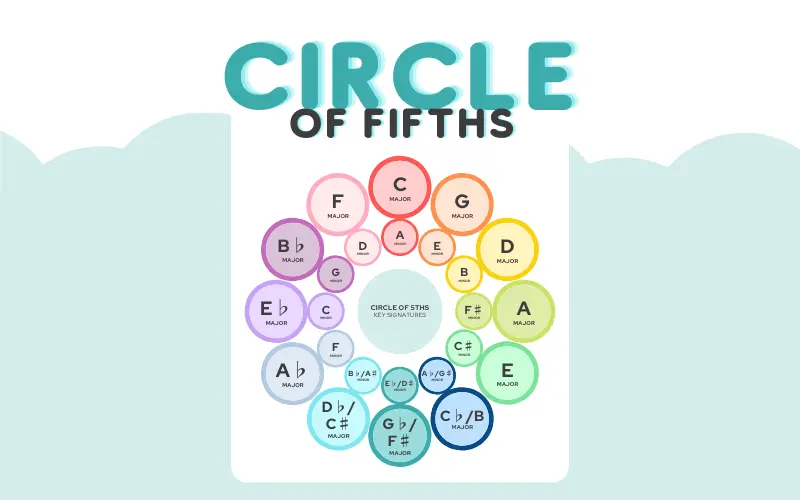
Start with the pattern: the circle of fifths
The circle of fifths poster is the reference I keep in view whenever we work on keys. Moving clockwise, each step adds a sharp; moving counter-clockwise, each step adds a flat—so the order of keys and the order of accidentals are the same predictable journey. Having it on the wall or the stand means a student can trace the pattern themselves rather than asking me, and over time the poster becomes the mental map they carry without it.
Circle of Fifths Poster
A printable reference for keys, sharps and flats, and how they relate—the one students keep coming back to.
Then build the skill: the key signatures worksheet
A poster explains the pattern; the worksheet makes it a skill. Here students identify and write key signatures themselves, moving from reading the circle to producing the answer without it. This is where recognition becomes recall, and where I can see which keys are secure and which still need the poster nearby.
Key Signatures Worksheet
Focused practice identifying and writing key signatures, building from the circle of fifths pattern.
The order matters. If a student meets the worksheet before they understand the pattern, they are back to memorising. The poster gives them the reasoning; the worksheet turns it into fluency.
How I use them together
- Trace before naming. When a new key comes up, we find it on the circle and count around from C, rather than my simply telling them the answer. The student does the reasoning.
- Learn the order of sharps and flats as one journey. Because the circle puts the keys and their accidentals in the same order, students learn both at once instead of as separate lists.
- Wean off the poster with the worksheet. Once the pattern is understood, the worksheet is where we practise producing key signatures from memory, glancing at the circle only when needed.
- Connect it to technique. Scales and arpeggios follow the same key relationships, so the circle of fifths ties key-signature theory directly to the technical work a student is already doing.
Putting it to work
Print the poster large and keep it near the piano; use the worksheet for lesson practice and homework. Together they turn key signatures from a memory chore into a pattern students can rebuild any time. Both sit alongside the rest of the music theory worksheets for scales, harmony, and analysis.
More theory support
Explore the full set of music theory worksheets for key signatures, scales, rhythm, note reading, and harmony—built to show the pattern behind the rule.