
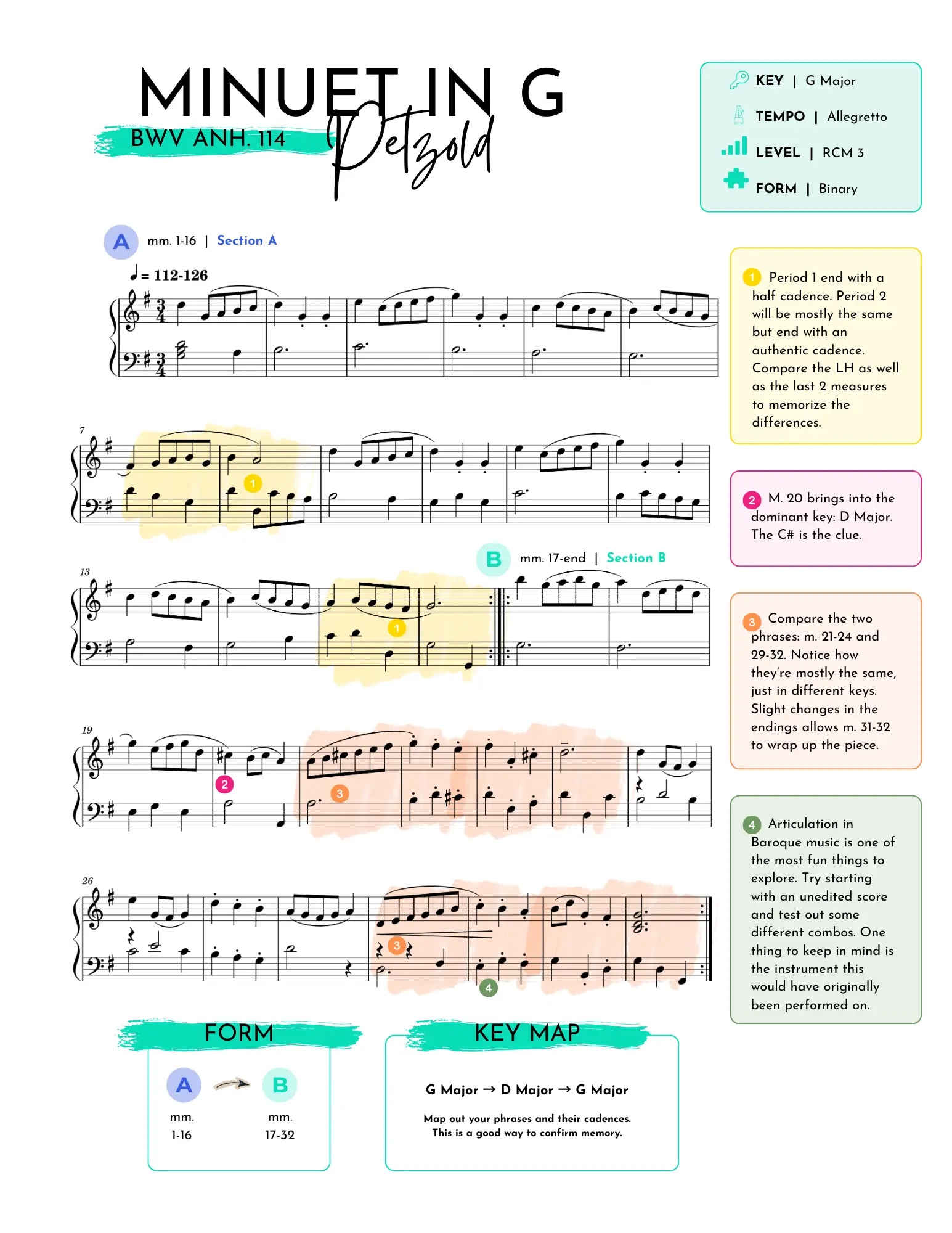
The Minuet in G is a milestone piece: often a student's first taste of Baroque style, hand independence, and dance rhythm all at once. It is short and its structure is tidy, which makes it a perfect place to teach a student how to read a piece's shape—not just its notes. Here is the whole minuet mapped out, plus the tips I use to give it real dance character.
- Composer
- Christian Petzold
- Catalogue
- BWV Anh. 114
- Key
- G major
- Form
- Simple binary
- Metre
- 3/4
- Level
- RCM Level 3
For two centuries this minuet was published as Bach's, because it appears in the Notebook for Anna Magdalena Bach. It is now credited to Christian Petzold, a Dresden organist. Students love that story—and it is a nice reminder that the notebook was a family scrapbook, not a book of Bach originals.
The big picture: simple binary
The minuet is in two sections, each repeated: ‖: A :‖ ‖: B :‖. What makes it simple binary is that the two sections, which are surrounded by repeat signs for easy visual identification, are different from each other. Section A does not return at the end of the piece, differentiating it from rounded binary.
Section by section
- A section (G major). The graceful opening melody sets out in G major and stays there for its entirety. While many composers modulate towards the end of section A, Petzold kept us home. In doing so, he keeps section A fully self-contained and complete sounding.
- B section (G Major → D Major → G Major). The music begins in the tonic, shifts away to the dominant (D Major) and then works its way back to G major.
A few teaching tips
- Feel three, lean on one. A minuet is a dance in 3/4 with a gentle weight on beat 1. Counting "ONE-two-three" with a light lift keeps it from marching. But be careful not to feel beat 1 too heavy in every measure. Keep the longer phrase in your ear and forward motion.
- Phrase in four-bar sentences. Breathe at the ends of phrases rather than every bar. Have the student sing or "air-play" the melody first to feel where it wants to breathe.
- Balance the hands. The right-hand melody should sit clearly above a lighter left hand. This is often a student's first real experience of voicing two lines at once—worth slowing down for.
- Match the articulation. Most editions want a light, slightly detached touch in quarter notes with legato within the phrases and most 8th notes. Decide the articulation together and mark it, so it is consistent every run. If you're working with an edited score pre-filled with articulation markings, release the ends of slurs with a light lift rather than a harsh and heavy downward release.
- Both sections have repetition within them. Compare each phrase group with the subsequent one: measure 1-8 vs. 9-15 and measure 17-24 vs. 25 to end. How are they the same and how are they different? This will help lock in memory.
Minuet in G Analysis (Printable)
A print-ready copy of the colour-coded form map to keep in the studio or hand to a student.
More analysis & theory
Explore more piece analyses and teaching ideas, or build the underlying skills with music theory worksheets for form, harmony, and analysis.