Some of the most useful theory practice does not look like theory practice. Music note sudoku is a plain logic puzzle on the surface—but to solve it, a student has to tell nine note values apart, over and over, without ever being asked to "name the note." That quiet repetition is exactly what makes it stick.
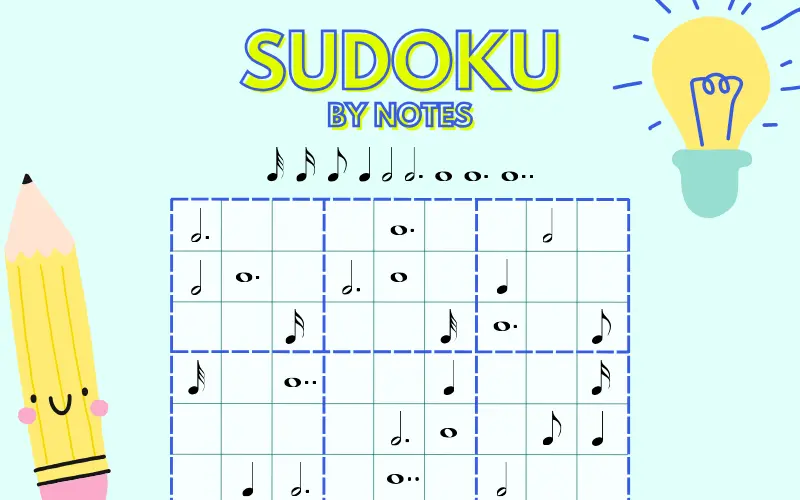
Music Note Sudoku
One printable puzzle plus a full answer key. Nine note values instead of numbers.
What is music note sudoku?
It is an ordinary nine-by-nine sudoku grid, with one change: instead of the numbers one through nine, the puzzle uses nine different note values—whole notes, half notes, quarter notes, eighth notes, and their rests. The rule is identical to the classic game. Each note value must appear exactly once in every row, every column, and every three-by-three box.
Because the solving logic is the same one many students already know, there is almost nothing to explain. The novelty is only in the symbols, and the symbols are doing the teaching.
Why note values work so well as a puzzle
To place a symbol in sudoku, you first have to be sure which symbol it is and confirm it is not already in that row, column, or box. That means a student scans the same nine note values dozens of times in a single puzzle, comparing and confirming each one. It is repetition without drill, and the student is checking their own accuracy the entire time because a single misread symbol makes the puzzle impossible to finish.
It also separates two skills that beginners often blur together: recognising a note value on sight, and doing something with it. Sudoku isolates the first skill, so recognition gets fast and automatic before it has to compete with counting, clapping, or playing.
Sudoku does not teach how many beats each note gets—that comes from other work. What it builds is instant, confident recognition of the symbols, which is the layer everything else sits on top of.
How I use it in lessons
I reach for this puzzle in a few specific situations rather than treating it as a worksheet to hand out cold:
- As a settling-in warm-up. A student who arrives wound up or unfocused can start the lesson with a few rows of the puzzle. It gets their eyes on musical symbols and their attention on the bench without me having to push.
- For early finishers. When one student in a back-to-back stretch finishes early, the puzzle is a calm, self-directed activity that is still music learning, not just filler.
- As low-pressure homework. Families are far more willing to do a puzzle than another worksheet, and it comes back finished. I pair it with the answer key so a parent can check it without needing to read music themselves.
- On the studio whiteboard. For a group class I copy a few tricky squares onto the board and we reason through them out loud together—naming each value as we rule it in or out.
Making it easier or harder
For a younger student, I sometimes fill in a few extra squares to start, or cover part of the grid so they only work one box at a time. For a student who finds it easy, I ask them to name each value aloud as they place it, or to say how many beats it would get in common time—so the puzzle quietly turns into a naming and counting exercise on the same page.
What is in the free printable
The download is a single printable puzzle with a full answer key, so it works for independent practice, homework, or an early-finisher activity with no prep on your side. Print as many copies as your studio needs. If your students enjoy it, the same idea shows up in the printable piano games collection in seasonal versions too, which is handy for keeping a familiar format feeling fresh.
More low-prep games that teach
Browse the full set of printable piano games for note reading, rhythm, intervals, and music terms—activities designed to carry real learning inside something students actually ask to play.