Note reading rewards repetition, but repetition is exactly what students resist. A card game solves that quietly: to win a hand of Go Fish, a student has to name notes, match them across the staff and the keyboard, and do it fast enough to keep the game moving. They think they are playing. They are reading.
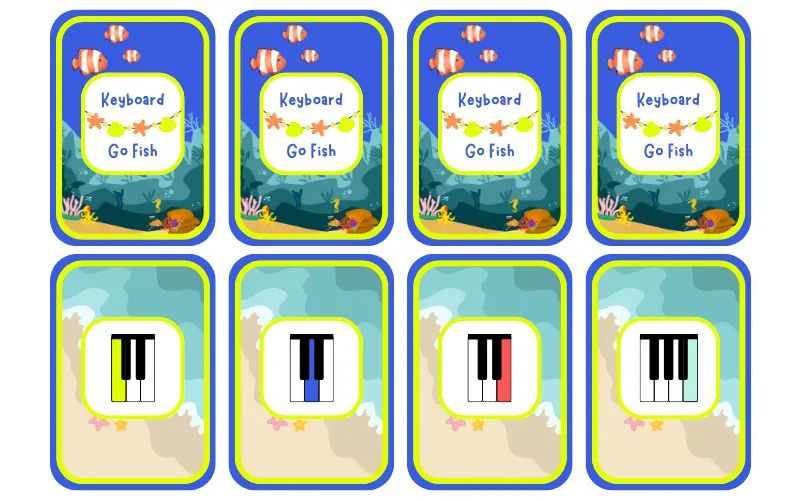
Go Fish: Piano Edition
Letter cards, piano-key cards, and treble and bass staff-note cards, with simple gameplay instructions.
What is in the deck
The game is the classic Go Fish you already know, built for piano students. The download includes a sheet of letter-name cards, a sheet of piano-key cards, and sheets of staff-note cards for both the treble and bass clefs, out to three ledger lines. A player collects pairs by matching a note across those different representations—the letter G, the key G on the keyboard, and G written on the staff are all the same note wearing three different faces.
That matching is the whole point. Beginners often learn a note name, its key, and its position on the staff as three separate facts. Go Fish forces those facts together into one connected idea.
How the game plays
Deal five cards to each player and place the rest in the middle—the pond. On your turn, you ask another player for a card that would complete a pair. If they have it, you collect the pair; if not, they say "Go Fish" and you draw. The player with the most pairs at the end wins. It runs comfortably one-on-one during a private lesson or across a small group.
To request a card, a student has to name the note out loud and picture its match. That spoken naming, repeated every turn, is worth more than a page of silent worksheet drilling.
How I use it in lessons
- I deal only what they know. The single most useful feature is that you can leave cards out. For a brand-new student I use just the letter and key cards for notes in their current hand position. Nothing on the table is a note they cannot read yet, so the game stays winnable and confidence-building.
- I grow the deck as they grow. Once hand-position notes are solid, I add the treble and bass staff cards, then extend to ledger lines. The same familiar game keeps stretching without ever feeling like a new task to learn.
- I use it to end a lesson well. A short hand at the end sends a student out on a win and a laugh, which does more for their willingness to practise than another two minutes of new material would.
- It is my go-to for siblings and group classes. Two or three students of slightly different levels can all play the same deck—I just adjust which cards each is responsible for naming.
Keeping it the right length
To keep a game short, set a timer or end when the first player runs out of cards. To stretch it, let players draw fresh cards from the pond when their hand empties. If a student is racing ahead, I add a rule that they have to play the matched note on the piano before they keep the pair—so the game folds playing back in alongside reading.
What is in the free printable
The download includes every card sheet plus clear gameplay instructions, ready to print and cut. A tip from my own studio: printing on cardstock or laminating the cards makes a set last for years of lessons. When you are ready for more, the printable piano games collection has other note-reading games that pair well with this one.
More games that build readers
Browse the full set of printable piano games, or work on the underlying skill with note-reading music theory worksheets. The aim is the same: fluent reading that transfers straight to the keyboard.