
Ear training is where a lot of students quietly stall. Intervals in particular can feel like a memory test with no handhold—a perfect fourth and a perfect fifth are just two sounds you are supposed to somehow tell apart. Flashcards that pair each interval with a colour and a feeling give students that missing handhold, so recognition becomes a response rather than a guess.
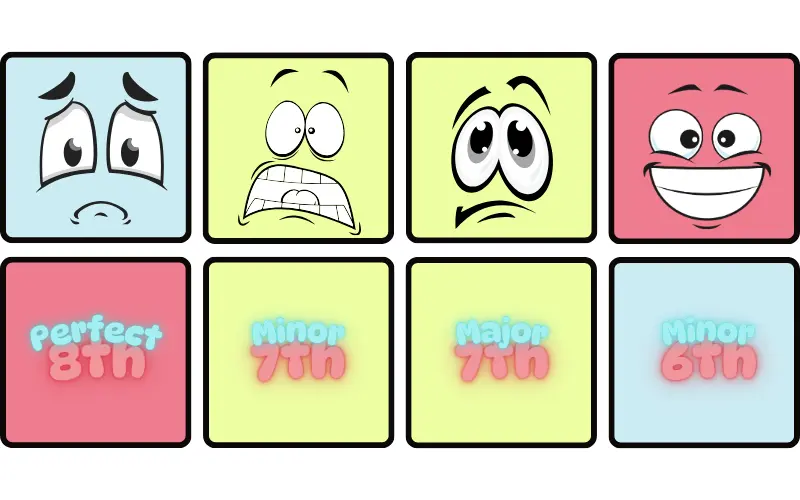
Musical Interval Flashcards
Colour-coded interval cards with the name on one side and an expressive face on the other.
What is in the set
Each card names an interval on one side and shows an expressive face on the other. The set is colour-coded by character—bright and happy, dark and sad, or dissonant and intense—so the visual reinforces what the interval sounds like. That gives a student two anchors for every interval: the emotion it evokes and the colour family it belongs to, both attached to the sound.
Why sound-to-feeling works
We remember sounds far better when they mean something. Asking a student to memorise that a minor second is a minor second is abstract; noticing that it sounds tense and "wants to resolve" is memorable. Connecting each interval to a feeling and a colour turns aural recognition from rote recall into something the student experiences, which is exactly why it sticks.
Because each card carries the interval's name as well as its sound and character, students build the theory label and the ear recognition together—rather than learning them as two separate subjects that never quite connect.
How I use them in lessons
- Play, then match. I play an interval and the student holds up the card they think matches. It is quick, it is low-pressure, and it tells me instantly what they can and cannot yet hear.
- Name the feeling first. Before we reach for the theory name, I ask what the interval sounds like—tense, open, sweet. The expressive faces give younger students the words, and the name follows naturally.
- Self-testing between lessons. Students play an interval on the piano, guess it from the sound alone, then flip the card to check. It is genuine ear-training homework they can do without me.
- Exam and sight-singing prep. For students working toward an aural exam, a few minutes of interval drilling each lesson builds the recognition those tests depend on.
Adjusting for the level
With a newer student I use only a handful of intervals at first—often the perfect fourth, fifth, and octave—and add more as those become automatic. For a student who finds it easy, I mix the cards, remove the visual cues, or ask them to sing the interval back before checking. The same deck stretches from first ear-training steps to steady exam preparation.
Putting it to work
Print the set, and cardstock or lamination will keep it usable for years of lessons. Interval work pairs naturally with the rest of the piano technique and ear-training resources, and with the interval reading you can build on the page through music theory worksheets.
More technique & ear-training support
Browse the full set of piano technique and ear-training resources—flashcards, technique charts, and tools that connect what students hear to what their hands do.