There is a reason snakes and ladders has lasted generations: it needs no reading, no strategy, and no explaining. That makes it a perfect frame to hang note reading on. Every square a student lands on becomes a note to name and play, so the practice keeps happening turn after turn while the game does all the motivating.
Musical Snakes and Ladders
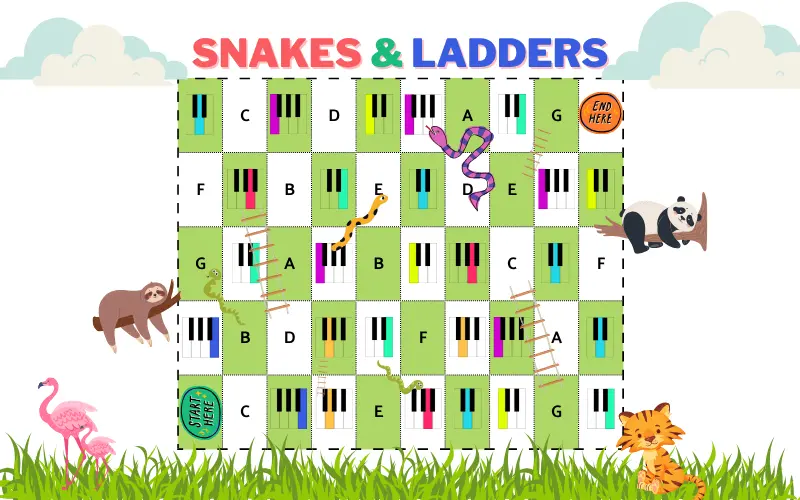
Two printable boards—one for letters and keys, one adding notes on the staff—with simple rules.
How the game works
Players start at square one and take turns rolling a die. After moving, the player names and plays the note on the square they land on—matching a letter, a key, or a note on the staff, depending on the board. Ladders send them climbing, snakes slide them back, and the winner needs an exact roll to land on the final square. It is the game everyone already knows, with one small musical job added to each turn.
Two boards, so it grows with the student
The download includes two versions, and the fact that there are two is what makes this last across a student's first years:
- The letters-and-keys board (A to E). This is where a true beginner starts. Squares call for note letters and keys within a five-finger range, so there is nothing on the board they cannot handle yet.
- The notes-on-the-staff board. Once a student is reading confidently, I switch to this version, which adds staff notes alongside the keys and letters. The game feels the same, but the reading demand steps up.
Because the two boards share the same rules, moving a student up is invisible to them—they are just playing again, on a board that happens to ask a little more.
How I use it in lessons
- To get playing, not just naming. The rule I never skip is that the student plays the note on the piano, not only says it. That turns every square into a tiny reading-to-keyboard rep, which is the connection beginners most need.
- As a group-class anchor. In a small group it keeps several students engaged at once—everyone is watching for their square and quietly reading along on other people's turns.
- For the wound-up or the worn-out. At the end of a long day, or with a student who needs a reset, a few rounds keep them reading without it feeling like more work.
- With a difficulty dial. For an extra challenge, a wrong note means missing the next turn; for a gentler game, I drop that rule entirely. Same board, adjusted to the student in front of me.
What is in the free printable
The download includes both game boards and clear instructions, ready to print. You supply a die and tokens—coins or buttons work fine. As with all my game printables, cardstock or lamination makes a set survive years of enthusiastic use. When you want more in this vein, the printable piano games collection has other note-reading games that pair well alongside it.
More games that build readers
Browse the full set of printable piano games, or work the underlying skill directly with note-reading music theory worksheets.