
Scales, chords, and arpeggios are the part of a lesson that is easiest to let slide. There is always a piece to polish, and technique quietly falls behind until an exam looms. A simple tracker fixes that by making the whole set of requirements visible on one page, so both the student and I can see at a glance what is learned, what needs review, and what is truly secure.
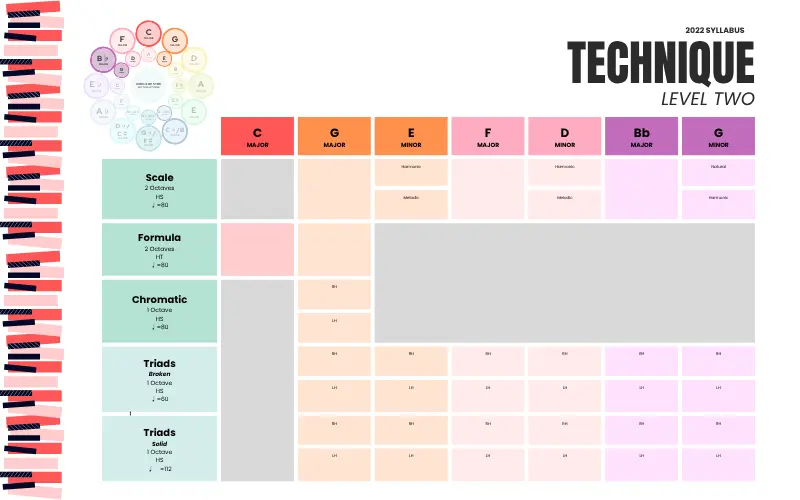
What is in the charts
Each tracker lays out the technical requirements for its level range in one organised place, with a few features that make it more than a checklist. There are spaces for minimum tempos so a student always knows the target, a circle-of-fifths reference for keys and their relationships, and progress checkboxes for recording when each element is assigned, learned, reviewed, and mastered. The charts follow the RCM technique requirements so nothing gets missed, and they come in three ranges to match where a student is.
The part that changes practice: a three-colour review
The checkboxes are built for a simple traffic-light system that I lean on constantly. Green means the student can play it at tempo, cleanly, with no hesitation. Yellow means it is there but shaky or under tempo. Red means it still needs real work. Colouring in each requirement turns a vague sense of "we've sort of done scales" into an honest, visible map of where things actually stand.
The value of the tracker is the distance between learned and mastered. A student can play a scale in a lesson and still not own it. The review columns keep that gap visible until the green is real.
Three charts, matched to the level
Pick the range that fits your student. Each works the same way, so a student moving up simply continues the system they already know.
Technique Charts, Levels 1–4
The technical requirements tracker for early levels, with tempos, a circle-of-fifths reference, and progress checkboxes.
Technique Charts, Levels 5–8
The intermediate tracker, with minimum tempos, key references, and the learn–review–master checkboxes.
Technique Charts, Levels 9–10
The advanced tracker for the final levels, keeping the full set of requirements organised through exam prep.
How I use them in lessons
- Assign in writing. When I add a new technical element, we mark it on the chart with the date. It stops "didn't we cover that?" and gives the student a clear list of what is currently on their plate.
- Review by colour, together. Every few weeks we run through the requirements and colour them green, yellow, or red. The student hears their own playing honestly, and the red squares write next week's practice list for us.
- Set the tempo target up front. Filling in the minimum tempo means the goal is never a mystery. A metronome number on the page is far more motivating than "a bit faster."
- Plan backward from the exam. In the months before an exam, the chart shows exactly how much is still yellow or red, so we can budget the remaining weeks instead of hoping it all comes together.
Putting it to work
Print the range your student is working in and keep it at the front of their binder so it is in view every lesson. It pairs naturally with the rest of the piano technique resources, and the circle-of-fifths reference on the chart connects straight to the key-signature work in the music theory worksheets.
More technique support
Browse the full set of piano technique and ear-training resources—technique charts, interval flashcards, and tools for connecting technical work to real playing.
The Paperless Piano Teacher is an independent teaching-resource website and is not affiliated with, endorsed by, or sponsored by The Royal Conservatory of Music. RCM and related names are trademarks of their respective owner, and are referenced only to describe the examinations these resources help students prepare for. Always confirm current requirements against the official syllabus.