
One of the first big leaps in note reading is when a student stops naming every single note and starts seeing how the music moves. Steps and skips are the foundation of that shift. Once a student can tell at a glance whether a melody walks to the next note or jumps over one, they are reading shapes instead of decoding letters—and reading gets dramatically faster.
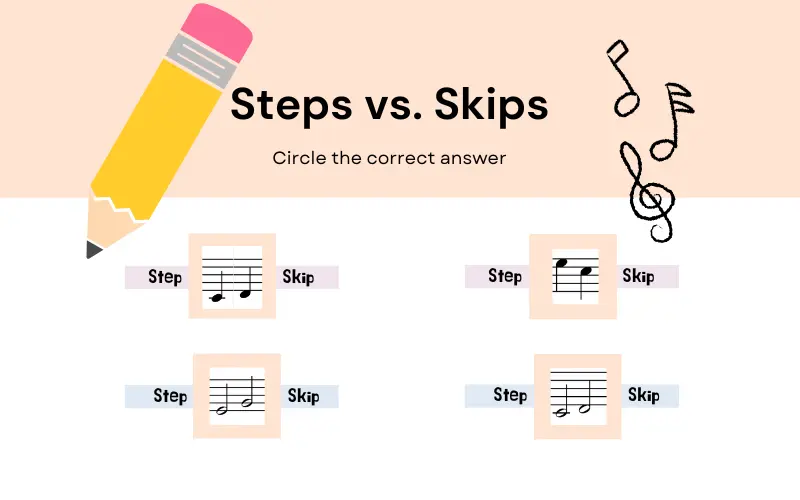
Steps vs Skips Worksheet
Students identify whether each pair of notes moves by step or by skip—pattern recognition on the page.
Steps and skips, in plain terms
A step moves to the very next note—line to the neighbouring space, or space to the neighbouring line. A skip jumps over one, landing line to line or space to space. On the staff, a step and a skip have distinct visual shapes: a step is a small shift up or down, while a skip leaves a visible gap. Teaching students to see those two shapes is what this worksheet is built around.
Why shape reading matters
Naming every note is slow, and it keeps a student's eyes locked on one note at a time. Reading by interval—starting with steps and skips—lets them process several notes as a single gesture: a scale run is "steps up," a broken chord is "skips." The letter names still matter for the landmark notes, but between those anchors, a student who reads movement covers ground far faster than one who spells out every note.
Landmarks tell a student where they are; steps and skips tell them where the music goes next. Together they are most of what fluent early reading actually is. I usually teach them side by side.
How I use the worksheet
- Point before you name. Before a student names anything, I have them trace the melody and call out "step, step, skip." Getting the movement first makes the note names easier, not harder.
- Move it to the keyboard. After the page, we play a short pattern and I ask whether their hand just stepped or skipped. Connecting the visual gap to the physical distance is where it clicks.
- Use it as a warm-up. A few rows at the start of a lesson primes a student to notice movement in the actual piece we open next.
- Carry it into real music. Once the worksheet is easy, I put a line of their current piece in front of them and ask them to mark the steps and skips there. The skill is only useful when it transfers off the worksheet.
What is in the free printable
The worksheet gives students focused practice identifying steps and skips, so the distinction becomes automatic before it has to work at speed in a piece. Use a page in the lesson or assign a section between lessons. It sits alongside the rest of the note-reading and interval work in the music theory worksheets, and pairs especially well with landmark-note reading.
Keep building fluent readers
Explore more music theory worksheets for note reading, intervals, rhythm, and harmony—each aimed at helping students turn what they see on the page into confident playing.