
Music history is where a lot of otherwise-confident students hit a wall. They can play the piece, but asked to remember what it depicts, which era it belongs to, or how the composer paints a scene, the details slide off. The fix that works best in my studio is not more reading—it is drawing. When a student illustrates the story a piece is telling, they have to decide what is actually happening in the music, and that decision is what makes it memorable.
Why drawing beats re-reading
A program piece—music that tells a story or paints a picture—gives students something concrete to hold on to. But a paragraph describing that story is easy to skim and forget. Turning it into a comic strip changes the task. To draw a panel, a student has to listen for what the music is doing, match it to an image, and put the events in order. That is analysis, disguised as an art project.
It also gives visual and creative learners a genuine way in. A student who struggles to write an essay about a symphony can often draw its story in vivid detail—and once the images are on the page, the vocabulary and the written answers come far more easily.
Students do not remember "the fourth movement depicts an execution." They remember the panel they drew of it. When the exam or the lesson question comes, the image surfaces first and the facts follow.
A Romantic example: Berlioz's Symphonie fantastique
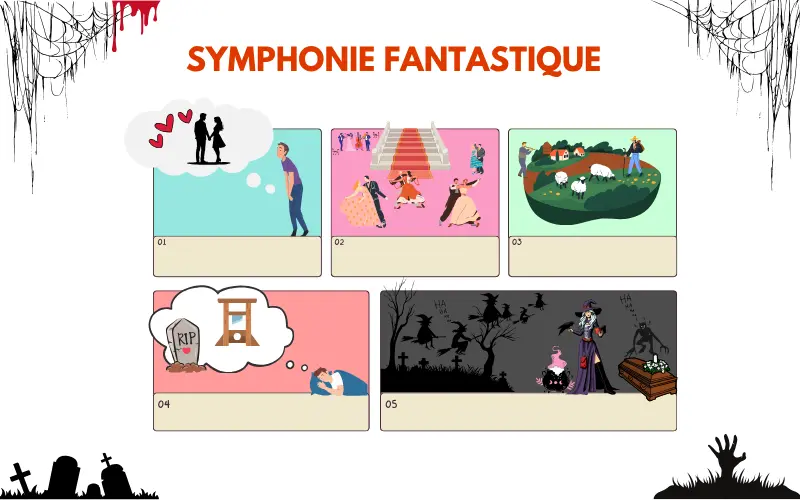
Berlioz's Symphonie fantastique (1830) is one of the great Romantic program symphonies—five movements tracing an artist's obsession, from a dreamy ball to a haunting March to the Scaffold and an eerie Witches' Sabbath. It is dramatic, strange, and perfect for this treatment, because every movement has a clear scene to picture.
The printable gives students a page of pre-drawn panels representing the five movements, where they describe each scene in their own words, and a blank page where they illustrate their own interpretation. Deciding how to draw the March to the Scaffold forces a student to actually notice the shift in the music.
Symphonie fantastique Comic Strip
A two-page comic strip: illustrated movement panels to describe, plus a blank template to draw their own.
A Baroque example: Vivaldi's Spring
Vivaldi's Spring, from The Four Seasons (1725), is one of the clearest cases of a composer painting with instruments. Birds chirp in high trills, a stream flows, a spring storm breaks with thunder and lightning, a goatherd dozes in a meadow, and villagers dance to a droning bagpipe. Each is a specific musical device tied to a specific image—ideal for a comic strip.
Working through this piece, students draw the signs of spring and the storm in the first movement, the peaceful meadow in the second, and the spring dance in the third. Along the way they are connecting a musical technique—a trill, a tremolo, an ascending scale—to what it represents, which is exactly the kind of listening these pieces are meant to teach.
Vivaldi (Spring) Comic Strip
A comic-strip activity for visualising the storm, the meadow, and the dance across Spring's three movements.
How I use them in lessons
- Listen first, in sections. We listen to one movement, then draw before moving on. Drawing the whole piece from memory is overwhelming; one scene at a time keeps the listening focused.
- Draw badly on purpose. I make it clear that stick figures are welcome. The point is the decision about what to draw, not the artwork, and lowering that bar gets even self-conscious students participating.
- Talk through each panel. Once a strip is done, the student walks me through it. That retelling is where I hear whether they have understood the piece, and where the exam-style vocabulary gets attached to their own images.
- Use it for substitutes and quiet weeks. These make excellent self-directed activities when a lesson gets shortened, or as cross-curricular work that links music with art and storytelling.
Building an era, not just a piece
Once students have drawn a couple of program pieces, the eras start to organise themselves. Vivaldi's neat, pictorial Baroque writing looks and sounds different from Berlioz's sprawling Romantic drama, and having drawn both, students can feel that difference rather than just memorising a list of era traits. That is when a comparison chart—like the ones in the music history resources—stops being abstract and starts making sense.
More music history support
Explore the full set of music history resources—era comparison charts, composer references, glossary tools, and required-listening study sheets built for lessons and exam prep.
The Paperless Piano Teacher is an independent teaching-resource website and is not affiliated with, endorsed by, or sponsored by The Royal Conservatory of Music. RCM and related names are trademarks of their respective owner, and are referenced only to describe the examinations these resources help students prepare for.