
"A half note gets two beats" is the kind of fact students can recite and still not understand. The trouble is that it is asserted, not shown—so the moment rhythms get more complex, or a dotted note appears, the memorised rule falls apart. The worksheets below all share one idea: make the relationships between note values visible, so a student reasons them out instead of guessing.
Start with the whole picture: the rhythm pie chart
Before any drilling, students need to see that note values are fractions of the same whole. The rhythm pie chart draws each value as a slice—so a student can see that two half-note slices, or four quarter-note slices, fill exactly the same circle as one whole note. It turns an abstract rule into a picture they can point to, and it is where I start almost every student.
Rhythm Pie Chart
Note values drawn as slices of a pie, so students see how the values add up to a whole.
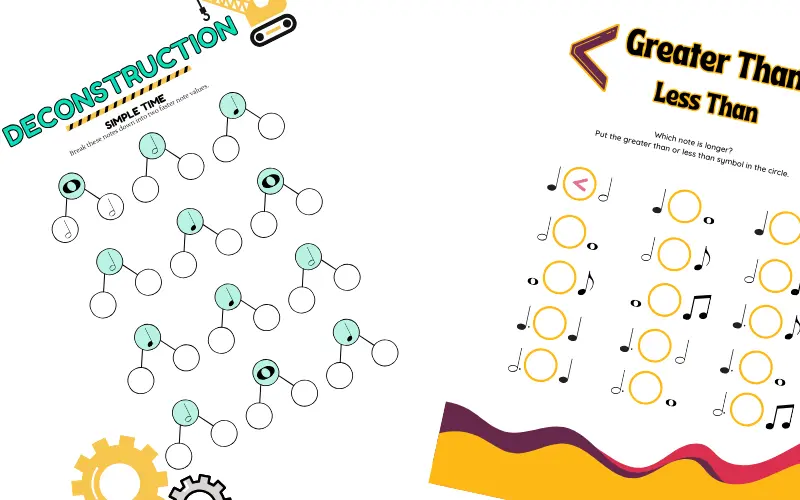
Break each value down: note-value deconstruction
Once students see the whole, the deconstruction worksheet shows the parts. Each note value is broken into the smaller values it contains—one half note is two quarters, one quarter is two eighths—so the doubling relationship is demonstrated rather than stated. This is the sheet that makes later work with subdivision and complex rhythms feel logical instead of arbitrary.
Note-Value Deconstruction
Each note value broken into the smaller values it contains—shown, not asserted.
Make the repetition painless: Pop It values
Understanding needs reinforcement, and this is the sheet that provides it without feeling like a worksheet. Built on the familiar Pop It grid, students colour their way through note values in common time—repetition disguised as an activity. I reach for it when a concept is understood but not yet automatic.
Pop It Values Worksheet
A Pop It–style colouring grid for practising note values in 4/4—repetition that doesn't feel like it.
The tricky ones: tied and dotted notes
Tied and dotted notes are where memorised rules usually collapse. This worksheet has students work out how many beats each one receives from the relationships they have already built, rather than memorising "a dot adds half." Once they can reason it out, dotted rhythms stop being a special case to fear.
How Many Beats: Tied & Dotted Notes
Working out the beats tied and dotted notes receive, rather than memorising a rule.
Whole picture, then the parts, then reinforcement, then the hard cases. Teaching note values in that sequence means each new idea rests on one the student can already see—so nothing has to be taken on faith.
How this fits a lesson
I rarely use all four at once. The pie chart and deconstruction sheets are teaching tools for the lesson itself; Pop It is homework or an early-finisher activity; the tied-and-dotted sheet comes out when those rhythms first appear in a student's music. Spread across a few weeks, they build rhythm understanding that holds up when the counting gets harder.
More rhythm & theory support
Explore the full set of music theory worksheets for rhythm, note reading, intervals, and harmony—each built to show the reasoning behind the rule.