
Mozart's Sonata in C Major, K. 545 is one of those pieces students can recognize before they can name it. The first movement is bright, balanced, and apparently straightforward. Under that polished surface is a wonderfully clear lesson in sonata form—and a surprisingly demanding lesson in control. There is nowhere for a lumpy scale, heavy Alberti bass, or shapeless cadence to hide.
- Composer
- W.A. Mozart
- Work
- K. 545, I
- Key
- C major
- Form
- Sonata
- Tempo
- Allegro
- Level
- RCM Level 8
How “easy” is the easy sonata?
Mozart completed K. 545 in Vienna on June 26, 1788. In his handwritten catalogue he described it as Eine kleine Klavier-Sonate für Anfänger—a little piano sonata for beginners. The familiar Italian title Sonata facile appeared in later publication history. The work was not printed until 1805, after Mozart's death.
“For beginners” tells us something real about Mozart's intended accessibility; it does not mean the piece is musically effortless. The transparent writing exposes every imbalance. In the current Celebration Series, the first movement appears in the RCM Level 8 Repertoire book.
The exposition presents contrasting musical ideas, the development unsettles and transforms them, and the recapitulation brings them home. Students hear a journey away from the tonic and back—not simply three labels to memorize.
The first movement at a glance
- Exposition, mm. 1–28: the themes move from C major to G major.
- Development, mm. 29–41: opening material travels through minor keys in a descending sequence.
- Recapitulation, mm. 42–73: the opening returns unexpectedly in F major, then works back to C major.
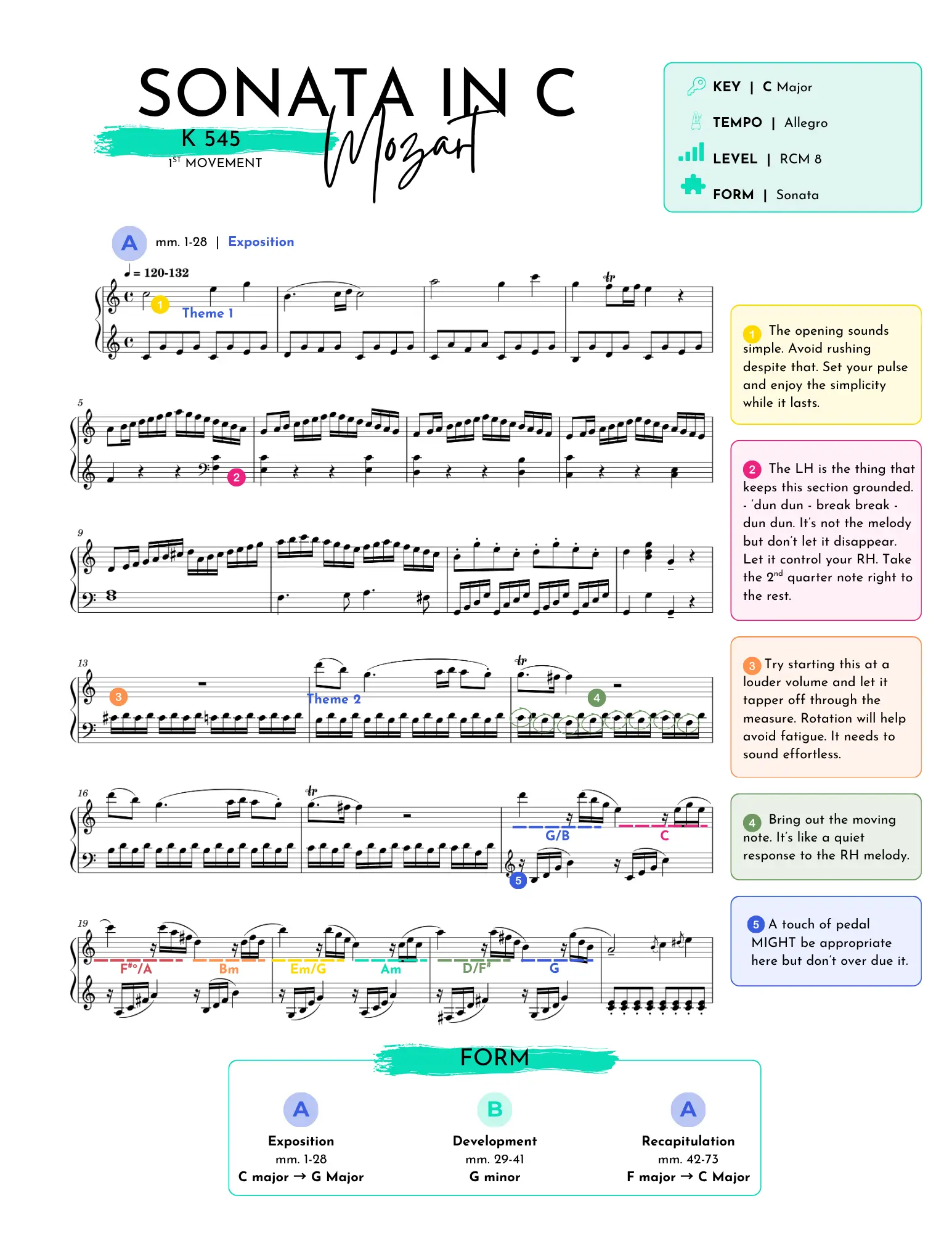
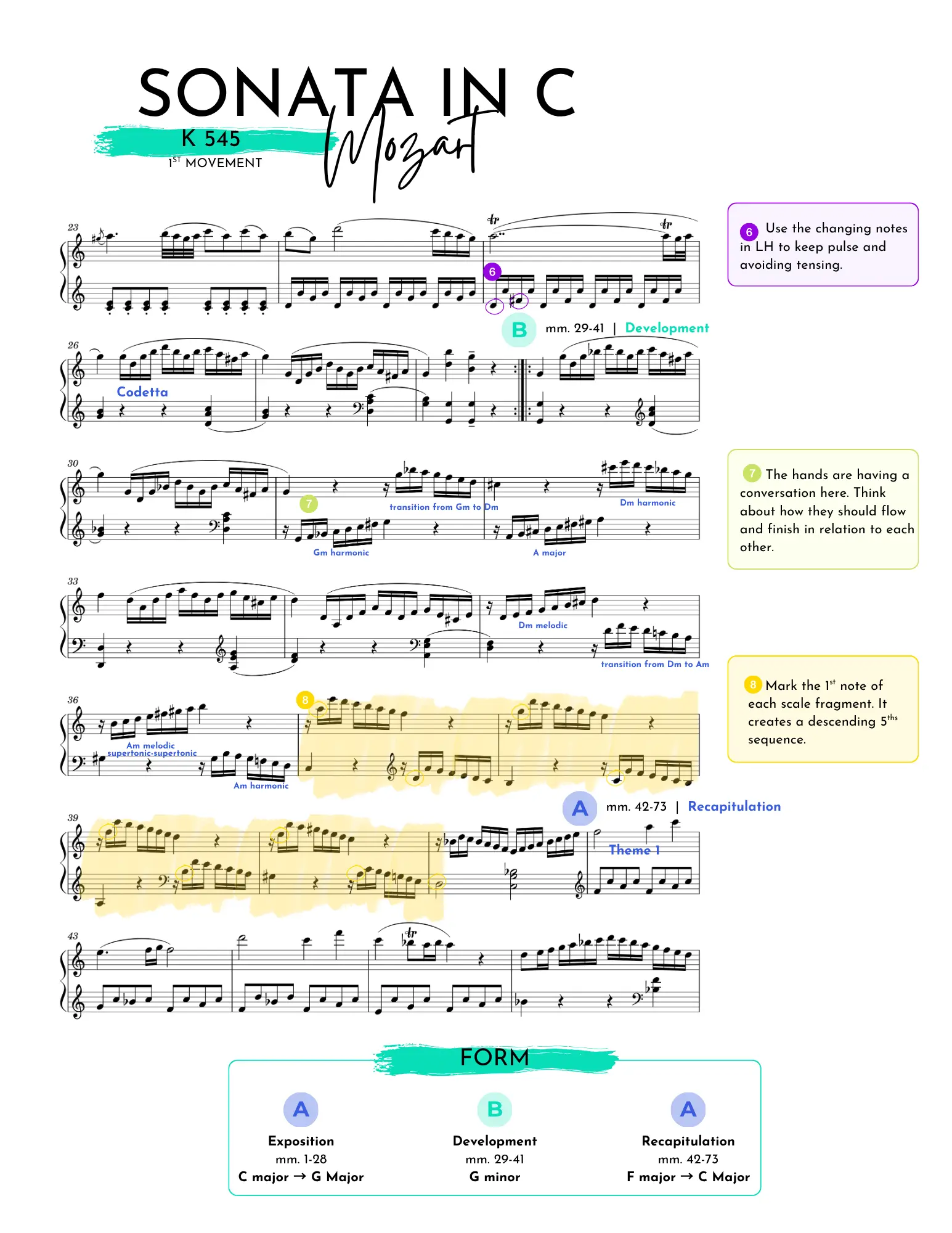
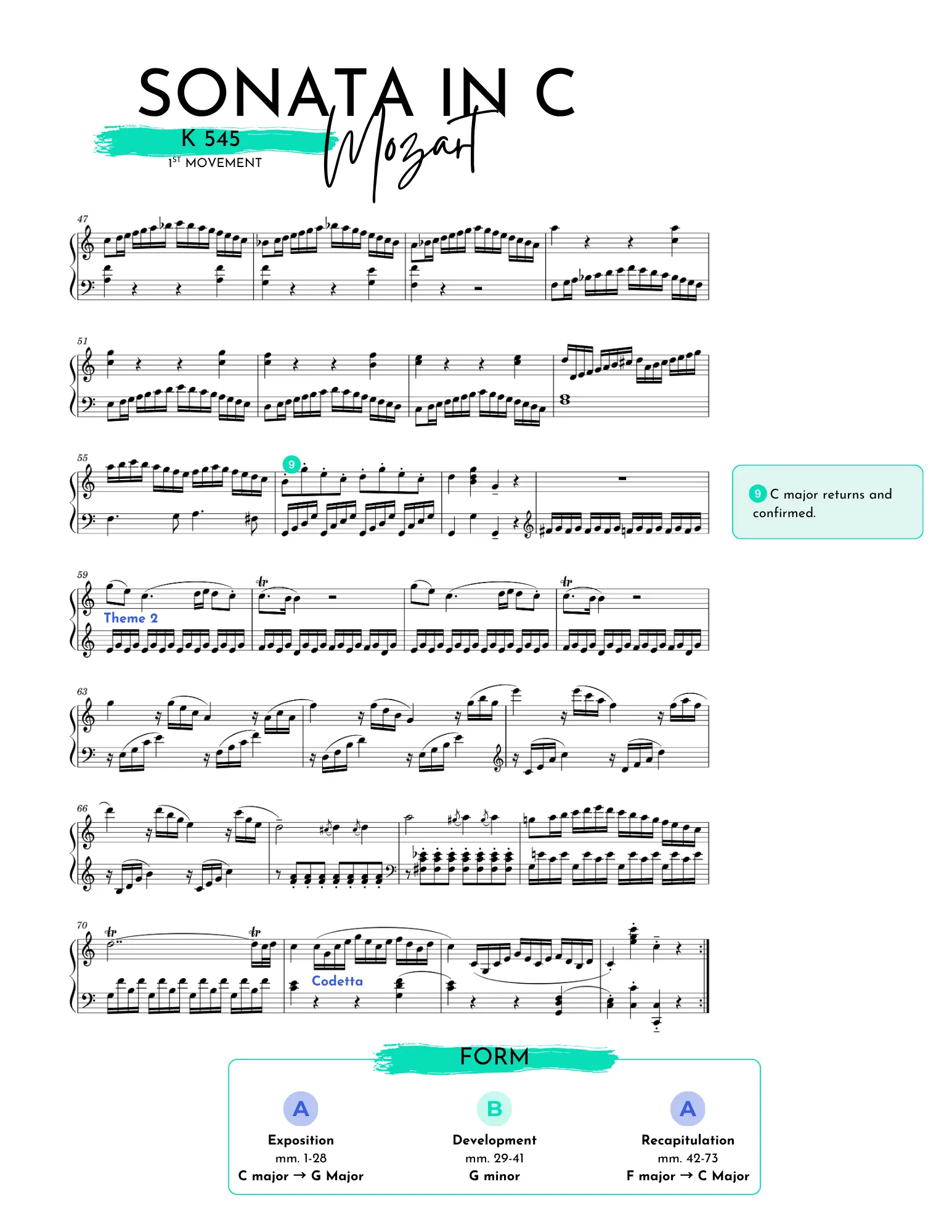
Exposition: introducing the cast
First theme, C major. The opening melody is supported by Alberti bass and answered by nimble scale work. Its simplicity makes articulation and phrase direction immediately audible. The cadence at the end of the opening unit provides the first clear punctuation.
Transition. Scale figures become the vehicle that carries us toward the dominant. Ask students to hear the growing pull toward G rather than treating the passage as a technical detour.
Second theme, G major. The new idea is graceful and conversational, with a lighter texture and different phrase character. Closing material confirms G major through decisive cadential writing.
Development: familiar material loses its footing
This development does exactly what we've been taught it's supposed to do. It fragments themes derived from the exposition and manipulates them through a number of keys. It begins with the opening idea in G minor, then D minor and sends it through a descending sequence. Fragments pass through changing harmonies while the bass keeps redirecting our ear. Have students highlight the starting notes and scale fragments; once they visualize the sequence, the section becomes far easier to understand and memorize.
The wonderfully unusual recapitulation
A textbook explanation might lead students to expect the first theme to return in C major. Mozart instead brings it back in F major, the subdominant. The music then finds its way to C major so that the second theme and closing material can finally return in the tonic.
This is excellent teaching material. Ask students to compare the opening and its return: same thematic identity, different tonal light. Circle the F in the returning bass and listen for the moment C major is re-established. The recapitulation is a process of coming home, not an instant reset.
Teaching the texture and technique
- Float the Alberti bass. Block each harmony first, then rotate gently through the broken pattern close to the keys. The left hand supports the phrase; it should not compete with it.
- Group the scales. Practise in rhythmic groups and shape toward harmonic destinations. Evenness includes tone and direction, not only correct timing.
- Keep articulation conversational. Decide where the melody speaks, answers, and breathes. Avoid making every slur or staccato equally important.
- Use clean, limited pedal. Much of the movement works with little or no pedal. Add small amounts for resonance where the harmony permits, never to disguise uneven fingers.
- Prepare ornaments away from tempo. Know where each trill begins, which fingers will play it, and how it releases into the following note.
- Save dynamic contrast for structure. Use colour and phrase direction to distinguish themes and sections instead of adding a dramatic swell to every two bars.
A practical lesson plan
- Colour the exposition, development, and recapitulation.
- Add a second colour layer for themes, transition, and closing material.
- Block the left-hand harmonies and name the main key areas.
- Practise scales in small rhythmic and directional groups.
- Compare the C-major opening with the F-major return.
- Start from every structural landmark without using the preceding run-up.
Sonata K545 Analysis (Printable)
A print-ready copy of the colour-coded form map to keep in the studio or hand to a student.
Sources and further reading
More sonata-form teaching
Compare Mozart's full sonata-form movement with the approachable model in Clementi's Sonatina, Op. 36 No. 1, or browse all piano analyses.