
Solfeggio sounds much harder than it is to read—almost every note is a sixteenth, and the single melodic line simply hands off from one hand to the other. That is also the whole challenge: making the stream sound unbroken, even, and controlled. Understanding how the piece is put together makes it far less intimidating, so here is the structure, then the tips I use to get it even and secure.
- Composer
- C.P.E. Bach
- Catalogue
- H. 220 / Wq. 117/2
- Key
- C minor
- Character
- Moto perpetuo
- Tempo
- Prestissimo
- Level
- RCM Level 8
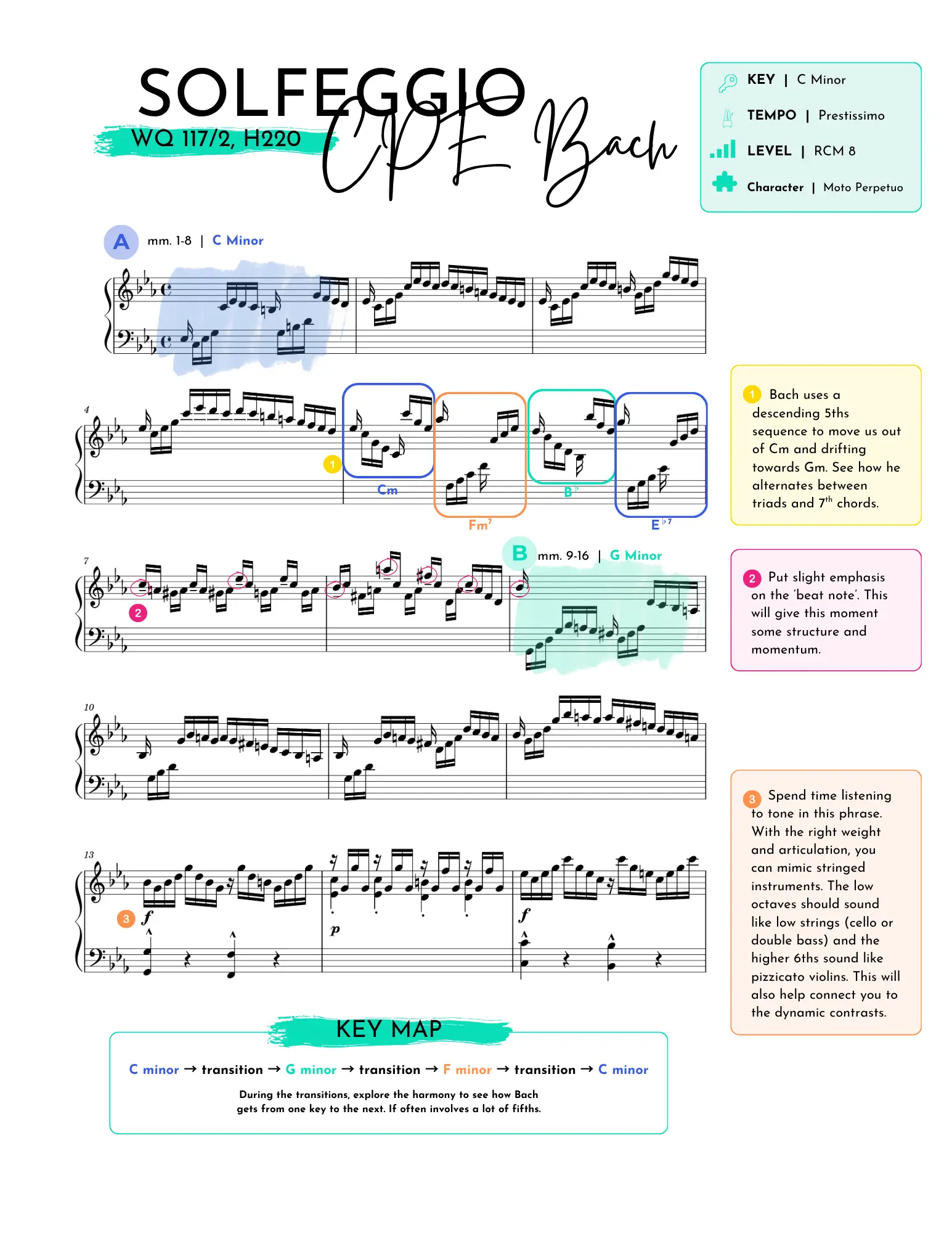
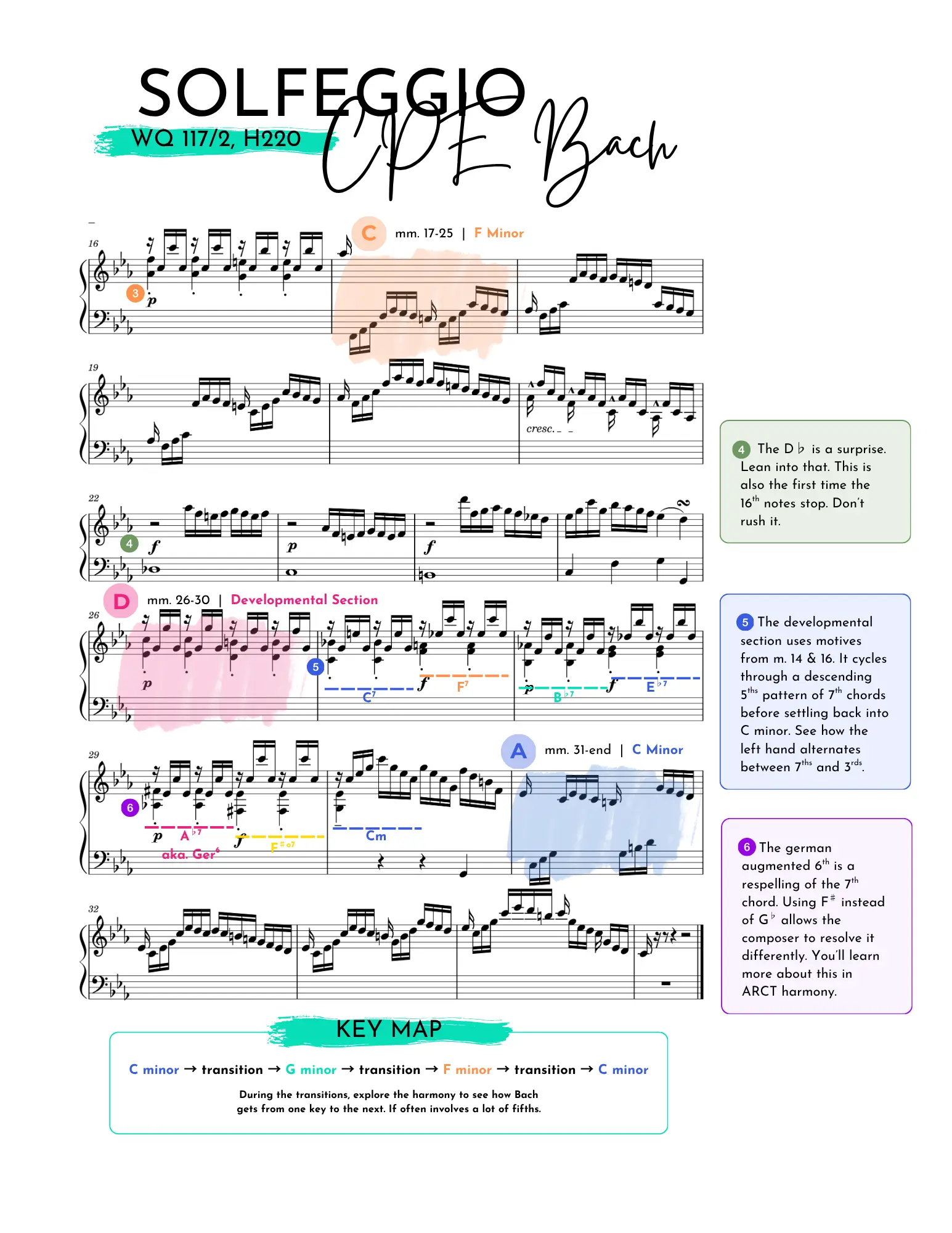
This is by Carl Philipp Emanuel Bach—one of J.S. Bach's sons and a leading figure of the expressive empfindsamer style. If you have looked at the Bach family tree, he is the C.P.E. on it. A nice reminder that "Bach" is a whole musical family.
The big picture: one line, two hands
Solfeggio is a moto perpetuo—Italian for "perpetual motion"—built from an almost uninterrupted stream of sixteenth notes. Much of the piece is driven by a single principal line passed seamlessly between the hands. Rather than organizing the music around sharply contrasting themes or a familiar dance form, C.P.E. Bach restates the opening idea in a series of tonal centres: first C minor, then G minor, then F minor, before eventually returning home. Sequential transitions and a more contrasting developmental passage connect those tonal destinations, making the harmony itself the clearest guide to the piece’s structure.
How it unfolds
- First section — leaving home. The piece storms out of C minor and moves through a descending fifths sequence before settling in G minor. This is where the ear feels the music being "carried somewhere."
- Second section — v. The opening idea restates in G minor. During the 2nd phrase of this section, think about orchestration. What instruments can your left hand mimic? Perhaps a deeper cello or double bass for the octaves, and a light pizzicato violin in the upper range.
- Third section — iv. Our opening theme now settles into F minor where it will further develop. Build toward the deceptive resolution onto D♭ in measure 22 (surprise!). And hold onto that moment. This is the first time in the piece we do not have running sixteenth notes. Savour it. Do. Not. Rush. It.
- Fourth section. This is the most texturally contrasting part of the piece, but its material is not entirely new: Bach develops the repeated-note and register-shifting figuration introduced earlier in the G-minor passage. Observe Bach’s sudden written shifts between piano and forte. The quick contrasts should sound immediate and dramatic rather than gradually shaped like crescendos and diminuendos.
- Fifth section — i. We're finally settling the opening theme back into the home key.
Although it is often called Solfeggietto, C.P.E. Bach’s original title was Solfeggio. A solfeggio was traditionally an untexted exercise used to train a singer’s ear and fluency; Bach transferred that idea to the keyboard, using rapid arpeggios and passagework to develop the player’s technique. Written in 1766 and published in 1770, this tiny study became perhaps his best-known work—and has challenged generations of piano students ever since.
A few teaching tips
- Make the handoff invisible. The single hardest thing is passing the line between hands with no bump or gap. Practise just the two notes on either side of each handover, slowly, until they sound like one hand.
- Evenness before speed. Any irregularity becomes obvious at Prestissimo. Slow metronome work and rhythmic variations help level the sixteenths before the tempo increases.
- Release tension before it accumulates. Fast playing needs a stable but flexible hand. Watch for locked wrists, raised shoulders or fingers lifting unnecessarily high, and identify small places where the hand can release.
- Find and shape the structural notes. Identify the notes that outline the harmony and direction of each run. Giving them a slight sense of destination prevents the passagework from sounding like a mechanical exercise.
- Speed is earned last. Prestissimo is the destination. Secure it evenly and cleanly at a moderate tempo, and let the speed come once the handoffs are seamless.
Solfeggio Analysis (Printable)
A print-ready copy of the colour-coded analysis to keep in the studio or hand to a student.
More analysis & theory
Explore more piece analyses and teaching ideas, or build the underlying skills with music theory worksheets for form, harmony, and analysis.